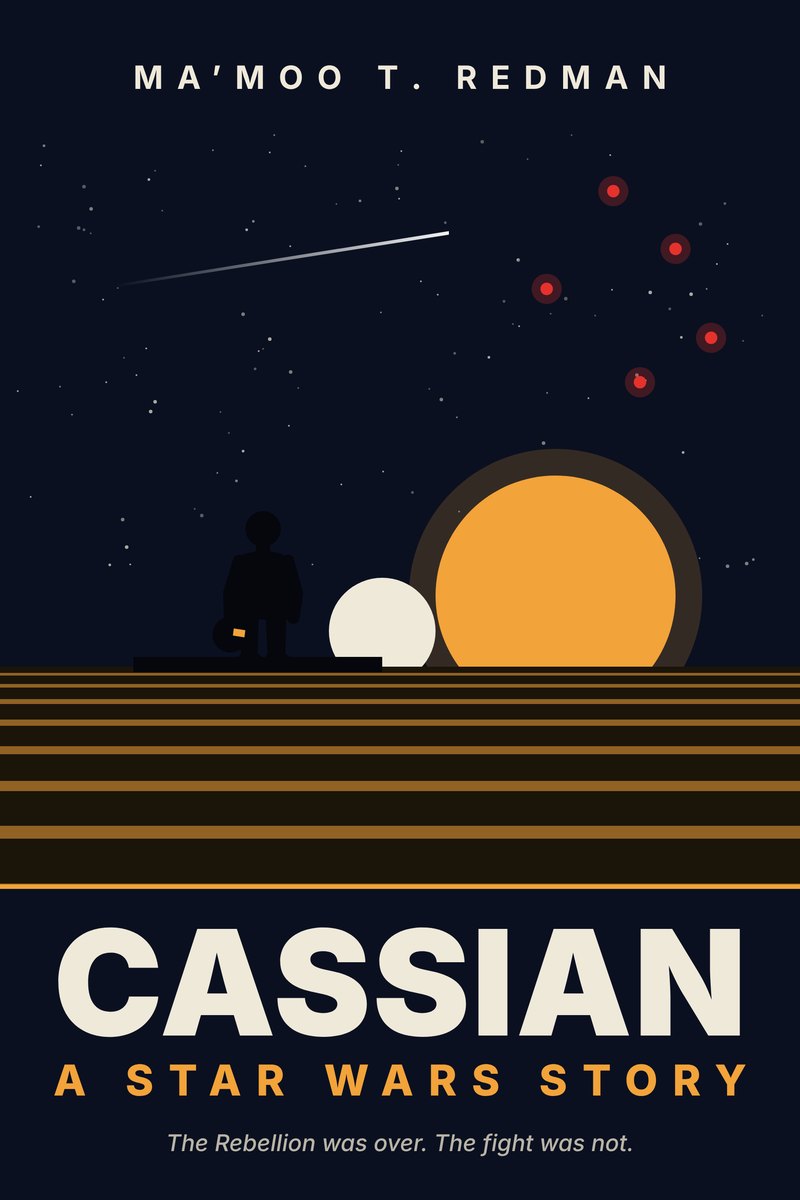
Prologue
Scarif
The sand gave under Cassian Andor’s boots like it wanted to keep him. He hauled Jyn Erso the last few meters up the beach with an arm hooked under hers, his other hand clamped around a rifle with nothing left in it, and when the transmission went out into the sky he sat down where he stood, because there was no place left to walk that was farther away than where they already were. She came down beside him. Her head found his shoulder, a small weight through two layers of torn fabric, and he held still under it the way you hold still for a bird that has landed on you.
Out past the shallows the sea had gone the color of a struck match. At the horizon the water was standing up. He found her hand without looking for it, and the light came across the beach and took the shadows off the sand one at a time.
Black.
Mina-Rau
The grain ran gold to every edge of the sky, and Bix Caleen walked through it with a baby wrapped against her chest and one palm spread across the back of his head. The stalks hissed against her thighs. Behind her the settlement had shrunk to a smudge of roofs, and ahead of her there was nothing but more field, and she walked toward it at the pace of someone who has decided not to be followed.
The baby stirred. She felt his breath go warm and damp through her shirt, and she bent her head until her mouth was against the soft whorl of his hair.
“You’ll know who he was,” she whispered. “One day.”
The wind took the rest of it across the field.
17 ABY
Chapter One: A Name to Carry
The condenser on the north rig coughed twice before dawn and quit, and Cass was out of his bunk before the second cough had finished echoing off the sheet-metal wall of the barn.
He did not bother with boots. He crossed the yard on cold packed dirt with the toolroll under one arm and the smell of dust and lubricant already thick in his nose, and by the time Hollis got there with the work lamp, grumbling about the hour and the cold and the general unfairness of machinery, Cass was flat on his back under the housing with a screwdriver handle pressed to the casing and his ear pressed to the other end of the handle.
“Third coil this season,” Hollis said.
“It’s not the coil.”
“It’s always the coil.”
“Quiet a second.” Cass shut his eyes. Through the steel and the wood and the bone behind his ear came the pump’s old stuttering rhythm, thump-thump-pause, thump-thump-pause, and inside the pause lived a thin dry grinding that should not have been there. He moved the screwdriver six centimeters down the casing. The grinding got louder. “Bearing. Back race. Somebody packed it with the wrong grease and it’s been cooking since the last rains.”
Hollis lowered the lamp until the light fell on the underside of the rig, where Cass was already working a seized collar loose with the heel of his hand. “We don’t have a bearing.”
“We have a feed trough lid.”
It took him forty minutes. He cut a disc from the trough’s galvanized lid with snips that had been his mother’s, drilled it, ground the burrs off against the barn wall, seated it behind the shaft as a spacer, and packed the whole assembly with grease he cooked off a rendered fat tin Hollis had been saving for his boots. When the pump caught and the condenser began to drip into the collection tank in slow bright beads, Hollis stood there with the lamp swinging at his knee and said a word under his breath that was mostly respect.
“That won’t pass any inspection in the Core,” he said.
“Nobody in the Core is drinking this water.”
Bix watched from the doorway of the equipment shed with her arms folded and the first light on one side of her face. She had been standing there since the second cough. She had watched him do this a thousand times, and each time the same two things rose in her chest and sat on top of each other like oil on water, the pride and the cold small fear underneath it, and she had long ago stopped trying to separate them. Cass slid out from under the rig with grease to his elbows. He saw her. He lifted the screwdriver like a salute, and she nodded once and went back into the shed.
The notice was waiting on the kitchen table when he came in for the midday meal, a stiff cream-colored flimsi with the New Republic’s starbird stamped in blue at the top. Bix sat across from it with a cup of tea going cold between her hands. She did not look up when the door banged.
Cass stopped with one boot over the threshold.
“It came with the supply drop,” she said. “Addressed to Kassian Caleen-Andor. The whole name.” She turned the cup a quarter turn on the table. “Nobody’s called you that out loud since the day I filed you with the registry.”
“Mom.”
“Applicant confirmed. Recruitment shuttle arrives Masa Veroff transfer station in nine days. Report with one bag.” She read it without inflection, like a list of parts. “Nine days.”
“I was going to tell you.”
“When? On the ramp?”
He came the rest of the way in and let the door swing shut. The room smelled of tea and the cold ash in the stove. There was a cracked mug on the shelf over the sink that had been cracked for as long as he could remember, and he put his eyes on it because it was easier than putting them on her.
“I knew what you’d say,” he said.
“Then you know I’m going to say it again.”
“Say it, then.”
She did not. She stood up, and she took the notice off the table, and she folded it in thirds with her thumbnail drawing each crease, and she set it down in front of his empty chair. Then she went out through the back door and across the yard to the low wall at the edge of the north field, and after a minute he followed.
They sat with the field in front of them. The grain had gone from gold to bronze, and at the far end of it the horizon looked soft and permanent, like a place where nothing had ever needed to happen. Cass turned a hydrospanner over and over in his hands, and the knurled grip left a pattern in his palm.
“You don’t know what’s out there,” Bix said. “I do. I’ve seen what happens to people who go looking for the war they think they’re owed.”
“I’m not looking for a war.” He stopped turning the tool. “I’m looking for him.”
She let the silence run. Out in the field a long gust bent the stalks flat, and then they stood up again one row at a time.
“Ask me,” she said. “I was there. I knew him better than any file the Republic’s got.”
“Then tell me one thing that’s real. Not the ones you tell me so I’ll sleep. Who was he.”
Her hands came up and rubbed once at her face, hard, and when they dropped her eyes had gone somewhere well past the grain. “Tired,” she said. “Down in the bone. The kind of tired that doesn’t leave when the work does. And he went and did it anyway, every time, whatever it cost, and then he got up the next morning and did it again.” Her mouth moved. “He wasn’t a hero out of a recruitment holo, Cass. He was a man who kept picking up a bill nobody else would touch.”
Cass said nothing. Anything he could say would have sounded small next to it.
She stood and brushed the dust from her knees and started back toward the house. Four steps on, she stopped with her back to him, and the wind pushed her hair across her cheek.
“Your father didn’t fight so you could stay small.”
The back door shut behind her. Cass sat on the wall until the sun went down behind the barn and the first stars came out hard and cold above the north field, and the hydrospanner in his fist had gone warm as skin.
That night Bix did not sleep. She lit the lamp in the kitchen, and she knelt at the cupboard under the sink and took out the pots and the dish bin and the rag sack, and she pressed her thumbnail into the seam at the back until the false panel came away. The chip sat in a twist of cloth. It was no bigger than her smallest fingernail, scuffed silver, with a hairline crack along one corner that she had told herself for years was nothing.
She held it under the lamp. She set it on the table and looked at it for most of an hour, and twice her hand went out toward it and drew back, and the second time she put her palm flat on the wood on either side of it, as if she were holding down a page in a wind.
At the end of the hour she picked it up and closed her fist.
The transport signal lit his comlink two days early. Cass packed in the dark, which took no time at all, since he owned two shirts and a toolroll, and he was on the landing strip at first light with the bag over one shoulder and the cold working up through the soles of his boots.
Bix came across the yard with a thermal flask in one hand. She stopped an arm’s length from him. For a moment she looked at the strip, at the freight lights blinking on the approach beacon, at anything but him.
“Hold out your hand.”
He held it out. She set the flask in it. Then she opened her other hand over his palm, and a sliver of silver dropped into his glove, so light he felt it only as a change in temperature.
“Don’t open it until you need to.”
“How will I know when I need to?”
“You’ll know.” She folded his fingers over it one at a time. “Eat something on the shuttle. They won’t feed you till Masa Veroff.”
The transport came down out of the paling sky with its running lights smeared by the dust of its own landing, and the ramp dropped with a hydraulic sigh. Cass went up it without turning around, and then, at the top, he turned around. She stood where he’d left her, one hand lifted to the level of her shoulder, not waving, only held there. Behind her the fields lay open to the horizon, gold going to grey.
I left Mina-Rau with a dead man’s last name, a chip I’d been told not to open, and a hydrospanner I’d taken off the shed wall without asking. I thought that was everything I was carrying. The ramp came up. The fields shrank to a stripe of color and then to a line, and then the clouds closed over it like a door.
Chapter Two: The Shuttle to Masa Veroff
The recruitment shuttle was a converted cargo hauler with eight rows of bench seats bolted to the deck plating, and it smelled of old coolant and young nerves. Cass took a seat by a viewport and watched the stars slide past in long streaks until a harness buckle across the aisle began to rattle with every shudder of the hyperdrive. A girl with a shaved head and a Chandrilan accent sat strapped in under it, one hand pressed flat against the restraint, jaw tight.
The rattle came from a loose retaining pin. He could hear it. By the fourth shudder he had unbuckled, crossed the aisle in a crouch, and pulled the pin out of its housing with his thumbnail.
“You’re not supposed to be out of your seat,” the girl said.
“It was going to come apart on the next jump.” He bent the pin back to its original angle against the edge of the bench, seated it, and tapped it home with the heel of the hydrospanner. The rattle stopped. He sat down again with his ears warm.
Two rows back, somebody laughed, a short surprised sound. Nobody said anything else, and Cass leaned his forehead on the cold plastic of the viewport and kept it there until the stars stopped moving.
Masa Veroff had a sky the color of weak tea and a landing field half-paved. The academy sat on a ridge above a river valley, and it looked like two different buildings that had been introduced at the last moment. The east wing was new, with clean white alloy and tinted glass and flags snapping above the main gate. The west wing was a skeleton of girders and tarps, and from somewhere inside it came the sound of a cutting torch, steady and bright and somewhere between a scream and a hymn.
The recruits stood in a loose file on the apron while a petty officer read names off a datapad. Cass stood with his bag at his feet and his eyes on the west wing, on the places where the framing didn’t quite meet and somebody had made it hold with cable and optimism, and a slow pleasure he had not expected began to spread through his chest.
It looked like something that could still be fixed.
His bunk was on the second floor of Barracks C, the left-hand bottom, and the mattress had been compressed by a succession of strangers into the shape of a shallow bowl. He had just dropped the bag on it when a duffel came flying through the doorway and hit the bunk across from his, and a voice followed it.
“You’re the farm kid.”
The boy who came in behind the duffel was eighteen, or looked it, broad through the shoulders and loose in the arms, with fair, sun-warmed skin, a day of stubble, and a smile that arrived before the rest of him did. He dropped onto the opposite bunk as though he had been living on it for years and stuck out a hand.
“Jacen.”
Cass shook it. The grip was dry and quick. “Cass.”
“Just Cass?”
“Just Cass.”
“Syndulla,” Jacen said, after a moment. He said it lightly, in the voice of a man mentioning the weather, and watched Cass’s face to see what it would do. Cass kept his face where it was. Everyone in the galaxy knew the name Hera Syndulla, and the name sat on the boy across from him like a coat that had been cut for someone else.
“Fine,” Cass said.
Jacen grinned, wider. “Good. Most people do a thing with their eyebrows.”
On the third morning Cass was reaching for a rack above his bunk when the hydrospanner slid off the shelf behind him. He heard the scrape and had no time to turn. Jacen, three meters away and bent over his own boots with his back to the shelf, put out one hand without lifting his head and the spanner smacked into his palm.
He looked at it. He looked at his own hand. He set the tool down on the bunk between them with the care of a man setting down something that might go off.
“That’s not a trick,” Cass said.
“No.”
“You’re Force-sensitive.”
“Untrained,” Jacen said. “My mother says I’ve got all the instincts and none of the discipline, which she says like it’s a joke.” He rubbed the back of his neck. “It stopped being a joke around the time I turned twelve.”
Cass had seen the holos of General Hera Syndulla like everyone had, the green of her skin lit bright under a dozen victory flags. Jacen’s hand came up from his neck and pushed through his own hair, a ragged fringe of that same green gone pale, spring-grass pale, as though someone had left the color out in the sun.
Neither of them said anything for a moment. Out in the corridor boots hammered by, and somewhere a voice was shouting about a missing locker key.
“Must be something,” Cass said. “Having a thing like that just come with you.”
“Doesn’t feel like it comes with me.” Jacen picked at a thread on the blanket. “Feels like I got handed it. Like somebody’s mailed me a house and I’ve got to live in it whether I like the floor plan or not.” His eyes came up, quick and level. “You’d know something about that, I’d guess.”
Cass bent over his bag and started to unpack the second shirt.
The flight sims were in a long low room in the new wing, twelve cockpits mounted in a row on gimbals with their canopies up like the mouths of birds. Instructor Renn, a lean grey woman with a limp she did not discuss, put them through a standard approach and break pattern, and it took her about ninety seconds of watching Cass to stop looking at her datapad.
He flew the way he fixed rigs. Before his conscious mind had finished reading the console his hands had already found the trim, the throttle, the flaps, three moves ahead of the thought, and the simulated craft turned in a tight clean arc that wasted nothing. When the instructor threw a power failure at him on the second pass, he rerouted the feed through the auxiliary bus before the alarm had sounded. Renn took two steps toward his cockpit and stopped.
“Where did you train?”
“I didn’t.”
“Nobody’s naturally this—” She did not finish the sentence. She wrote something down on her datapad and moved on to the next cockpit.
Jacen’s cockpit sat on the end. Cass watched him through the gap between canopies. The boy flew as if the ship were a sense the others hadn’t been issued. He didn’t calculate the turn, he simply knew where it needed to be and arrived there a half-second ahead of the instruments, shoulders loose, eyes unfocused, head tilted like a man listening to a song through a wall. When the sim gave him a missile lock he broke right a breath before the tone sounded.
They landed their sims within a second of each other and sat there in the stopped gimbals, looking across the aisle through two canopies at each other, and Jacen lifted two fingers off his controls in a flat salute.
The tactical drill was a ridge-line problem, a defended position and a rolling timetable of reinforcements, and the manual answer was a staggered approach from the north slope. Cass looked at the map for a full minute and said, to nobody in particular, that the manual answer got everybody killed on the second wave.
“Show me,” said the drill instructor.
He rerouted his squad along the dry riverbed that the planners had marked as impassable. It was three hours of wet boots, but it put them behind the defenders’ reinforcement line with their weapons dry. The simulated position fell in forty minutes. The instructor wrote unauthorized route deviation on one line of the scoring sheet and objective achieved, early on the line beneath it, and stood there looking at the two lines for a while.
Jacen’s squad took the same problem a different way. Cass could not have named the logic. Jacen simply moved his people to the left at the moment of the second wave’s first movement, a full minute before the aggressor force had committed, and when the wave came it hit empty ground. Afterward, in the mess, Cass asked him how he’d known.
Jacen stared at his tray. “I didn’t. I was standing there and I had the feeling that everyone was in the wrong spot, and I moved them.”
“That’s it?”
“That’s it.”
“That’s not a plan.”
“No,” Jacen said, and tore a roll in half. “It’s worked so far, though.”
On the weapons range, Cass’s score came back from the target controller with a tolerance so tight that the range officer, a heavyset man named Tarrow who had spent a lot of years looking at other people’s numbers, took the printout out of the tray, read it, put it back, took it out again, and then walked over to the booth and checked the settings on the sensor.
“Do it again,” he said.
Cass fired the same string. The pattern fell in the same place, a cluster so tight it might have been stamped.
Tarrow stood there for a while. “Who taught you to shoot?”
“Nobody. We had a blaster on the farm for womp rats.”
“Womp rats,” Tarrow said, and went to find a different file.
The trouble came in the sixth week, during a squadron-coordination exercise. Cass’s wing was flying against an opposing force of automated training drones that had been built to follow a script, and midway through the run the script put his wing into a crossfire the planners had clearly intended them to lose. He watched it close around them on the tactical display, three seconds from a kill, and in those three seconds his hands went to the console of the nearest tethered drone and opened the control panel on the access port.
He rewrote its behavior in less than a minute. A single instruction turned the drone’s wingman around to cover its flank, and the whole opposing formation, now acting on two competing sets of assumptions, came apart like wet paper. His wing took the objective in half the projected time.
The reprimand arrived within the hour, a flat grey slip with the words unauthorized modification of training assets printed across the top. He read it standing in the corridor outside the commandant’s office, with the hydrospanner still in his belt.
Jacen leaned against the opposite wall with his arms crossed and his mouth working at the corner. “You could have just flown the exercise.”
“The exercise was broken.”
“So you fixed it.”
“So I fixed it.”
“That’s going to get you in trouble someday.” Jacen’s smile went away by degrees. “The kind you can’t fix your way out of.”
Cass looked at the slip. He folded it and put it in his pocket with the first week’s meal chits, and he told himself he hadn’t been listening. But he stood in the corridor a moment longer after Jacen had gone, with his thumb rubbing slowly along the grip of the tool at his belt.
Chapter Three: Trial by Fire
Instructor Renn kept the personnel review short and the room cold. She sat behind a desk the color of an old tooth with Cass’s file open in front of her, and she ran one finger down the margin of the page until she reached a line near the bottom, where the field marked FATHER held a single word in the registry’s block capitals.
UNKNOWN.
“Your mother’s listed,” she said. “Father’s not. Was that her choice or yours?”
“Neither. It’s just what’s true.”
It was not true, or not quite, and she let a silence run long enough for both of them to know it. The room’s recycler ticked. Out in the corridor, a cart rolled by with one bad wheel.
“I’ve read a lot of files,” Renn said. “Mostly the ones that say unknown are covering something.” She closed the folder. “I’m not going to ask what. I’d like you to remember that the question exists.”
When he stood to leave he noticed the access log tab on the edge of the datapad, a small grey bar beneath her hand, and the top line of it caught his eye before she covered it. His own file, opened at 0214 the previous night, from a node address that was not the academy’s.
He did not say anything. He walked out into the corridor and down the stairs, and he did not breathe all the way out until he was in the yard.
That night the dormitory was dark and the air in the yard held a damp that fogged on the glass of the comm shack. Jacen found him on the loading steps at the back of the barracks with a scavenged receiver in his lap and a pair of cracked earpieces looped over one ear, turning a dial a hair at a time.
“What is that?”
“Old transmissions.” Cass did not look up. “Rebel-era. Most of it’s static and dead codes. Some of the archives never got wiped. If you know where to listen—” He stopped. The sentence was already out in the dark and sounded like exactly what it was.
“You’re looking for him.”
Cass turned the dial another degree.
Jacen sat down beside him on the step without asking. He did that a lot, Cass had begun to notice, took space beside people as if nobody had ever told him it might be refused. “My father died on Lothal,” he said. “Holding a fire back so the rest of them could get out. I wasn’t old enough to remember his face. I grew up on my mother’s stories. I used to put my ear to the wall in the dark and listen for him through it.” He rubbed the heel of his hand along his knee. “Like if I got the frequency right, he’d answer.”
“Yours died fighting.”
“Mine—”
“Mine chose it.” Cass’s voice stayed level, and the dial under his thumb stopped moving. “Scarif wasn’t a thing he got caught in. He knew. He looked at it and he knew he wasn’t coming back, and he went in anyway. Left her standing in a field with a baby and a name nobody was allowed to say.”
“That’s not so different from dying fighting.”
“It’s different when you leave somebody behind on purpose.”
Jacen opened his mouth and shut it. He had the decency, Cass thought later, not to fill the quiet with something clever, and the two of them sat there while the receiver hissed and popped and spat out the ghost of a hundred dead channels. Then for half a second the static parted and a voice came through, thin, flattened, torn by distance, reciting a string of numbers that meant nothing to anyone anymore. Cass didn’t know the voice. His chest knew the shape of it before his head did. His hand closed hard around the receiver, and the voice was gone.
He sat there afterward until the cold came through his jacket, and then a long time after that.
On Mina-Rau the man came in the late afternoon, on foot, up the dirt road from the transport depot with his hands visible at his sides.
Bix saw him from the kitchen window and kept stirring the pot, and she did not stop stirring until he was at the gate. She put the spoon down on a folded rag. She dried her hands on her apron. By the time she was out on the porch she had already catalogued him: trader’s coat, a good one, too clean for the road; boots resoled by someone who knew what they were doing; no weapon she could see and no place for one that she couldn’t also see. His hands were soft, and his walk was not.
“Mistress Caleen.” He smiled with half his face. “Forgive the intrusion. I’m told you have a child.”
“You’ve been told wrong.”
“A boy.” The smile did not shift. “Eighteen, I’m told. Good with machines. Very good.”
“There’s nobody here but me and a hired hand.”
“Of course.” He looked past her at the house, the yard, the pump, the leaning barn, and let his eyes rest on each one in the way of a man pricing them. “I won’t keep you. Only, if the boy should write — if there should be any message — I’d be grateful if you let me know.” He held out a card, plain white, one line of numbers, and when she didn’t take it he laid it on the porch rail and weighted it with a pebble. “Good afternoon.”
She stood with her fists closed at her sides until his shape dwindled into the heat shimmer on the road. When she finally went inside the stew had scorched. She turned off the burner and set both hands on the edge of the stove, and the iron was hot, and she held on.
The final exercise of the term was a combat drop, with six two-person training craft launched from the carrier ship Daybreak into a simulated hot zone over the river valley. The plan, as briefed, was a controlled descent over a target grid, the usual choreography of live-fire practice rounds against recorded threats, with every weapon loaded blank and every sensor tuned to a safe margin.
Cass and Jacen’s craft was number four. It was a slab-sided trainer with a fixed twin cannon, one seat forward and one behind, and a flight computer that had been rebuilt so many times it resembled a patchwork quilt. Cass had the front seat. Jacen had the rear and a harness he kept hitching at the shoulder.
“Craft four, you’re clear to drop.”
The deck fell out from under them. For a second there was nothing but wind in the seams of the hull and the slow roll of the valley rising to meet them, brown and green and threaded with the silver of the river, and Cass gripped the yoke and watched the target grid open on his screen.
The first sign was small. A threat marker on the console that should have been a static projection moved.
“That’s not scripted,” he said.
“What?”
“The marker. It’s tracking us.”
A second marker lit, and then a third, and the console emitted a low pulsing tone that Cass had heard exactly once before, in a classroom, as an example of what a live targeting lock sounded like. Something screamed past the canopy and tore a strip of paint off the wing, and the training comm, which had been alive with the chatter of the other craft, dropped suddenly to a hush.
“Craft four, abort, abort, this is not—” The voice from the carrier cut off in the middle of a word.
“Cass.” Jacen’s voice had gone flat and careful. “The sim’s not running the sim. Somebody’s inside it.”
“I know.”
“The cannons are hot.”
“I know.”
He opened the maintenance panel under the console with his left hand and started pulling cables with the right. A training craft’s flight computer was a stack of failsafes bolted on by people who feared the students, and each of those failsafes was a door somebody had forgotten to lock. He kicked the autopilot. He shut off the targeting relay. He took the yoke in both hands and put his full weight on it, and the trainer, which had been built to fly on rails, bucked and began to fly like a ship.
“Left,” Jacen said.
He banked left. A bolt of real fire seared through the space where the right wing had been.
“How are you—”
“I don’t know. It’s just there before it happens.” Jacen’s eyes were half-closed, his head turned slightly away from the canopy, the cords standing out in his neck. “Down. Now. Hard.”
Cass pushed the nose into a dive that made the airframe groan. Below him the valley wall rose, grey rock and scrub, and he threaded the trainer through a cleft the width of its wingspan with a hand’s breadth to spare on either side. The shriek of metal on stone flared and faded. Behind them the rogue drone that had been shadowing them came apart against the wall.
“Right. Two more. Coming in low.”
“Where’s the hole?”
“Under them. Go under.”
They went under. The first drone overshot. The second took a long slow turn that Cass saw coming and had no way to stop, and he did the one thing his hands knew to do, killing the thrust and dropping the trainer straight down like a thrown stone, and the drone’s bolt cooked the air a meter above the canopy. Heat flooded the cockpit. The console went red. Cass reached out with his left hand, shorted two fuses with the head of the hydrospanner, and the comm crackled alive.
“—all craft, all craft, the training grid has been compromised, repeat, this is a live engagement, base defenses are coming up, hold your—”
“We’ve got it,” Cass said into the comm. His voice sounded far away. “Four’s got the north approach.”
He and Jacen held the north approach for eleven minutes. When the base’s real batteries finally came up and the sky above the valley lit with a net of proper fire, the last of the rogue drones folded into itself and fell, burning, into the river. The two of them sat with the canopy cracked and the console dead, breathing in the smell of scorched wiring, and neither of them could speak.
Two of the other trainers had taken hits. One cadet was pulled out of a crumpled cockpit with a broken arm, cursing steadily. The base stood.
Chapter Four: Legacy Ignited
They gave him the dressing-down at 0800 in the commandant’s office, with the sun just beginning to slant across a desk that had not yet been fully unpacked from its crate. Commandant Teller, a gaunt man with a burn scar along one jaw, read aloud from a charge sheet: unauthorized override of flight systems, disabling of safety interlocks, modification of a training craft during a live evolution. Cass stood at attention through all of it with the hydrospanner in his belt and his eyes fixed on the wall behind the commandant’s head.
“Do you have anything to say?”
“The interlocks would have killed us, sir.”
“The interlocks,” said Teller, “were doing their job, which was to keep you from killing yourself.” He folded the sheet. “You will be written up. The write-up will say what I’ve said. It will go in your file.”
“Yes, sir.”
Teller stood. He walked to the window and looked down at the apron, where mechanics were dragging the wreck of trainer six toward the hangar, and for several seconds he said nothing. “The other thing that will go in your file,” he said, “is a note in my own hand. I’m told the probe that came through that grid was sophisticated enough to defeat three layers of our security. I’m also told nobody on this base did what you did.” He did not turn around. “That’s all, Cadet.”
In the corridor Jacen was waiting with a datapad held up to his face. He turned it around so that Cass could read the line at the bottom of the commandant’s note, which had been transmitted to the central register while they were still inside, and which read, in two words and a pair of initials: EXCEPTIONAL. ADVANCED TRACK.
“You’re in trouble and promoted in the same paragraph,” Jacen said. “I think that’s a record.”
“Sounds about right.”
“You don’t fly like a recruit, you know.” Jacen lowered the datapad. His grin was still there, but the humor had thinned out of it, and what was left sat quiet behind his eyes. “Out there. I was watching you. Everybody else was reacting. You were already two moves past it. You fly like somebody who’s been at war a long time.”
Cass looked at his hands. There was a burn blister across the heel of the right one, and the dried streak of a cut along his thumb. “I don’t know where it comes from.”
“I think you do.”
That night the barracks was empty. Most of the squad had gone to the mess to hear the broken-arm cadet tell the story for the fifth time, and Cass sat alone on his bunk with the light off and the blister throbbing in time with his pulse.
He took the chip out of his shirt pocket. He had carried it for seven weeks, sewn into the lining of his jacket and then taken out and sewn back in, and he had stopped, somewhere in the last few days, being able to tell the difference between the weight of it and the weight of the thing it would say. He set it on the lip of the datapad’s emitter. It clicked into the slot. The projector hummed.
A hologram bloomed over the bunk, blue and grainy and unstable at the edges, its image jumping every few frames the way a recording does when the memory behind it is failing. A man sat in a cramped room, a bare bulb behind him and the wall at his back marked with water stains. He was perhaps thirty, perhaps older, with a lean face and hard dark eyes and the kind of stillness that comes when someone has spent years not letting a thing show.
Cass had never seen the face. He knew it at once. He had been looking at some version of it in every mirror he’d ever passed.
“If you’re seeing this,” the man said, and paused, and the hologram stuttered over the pause, “then I didn’t make it back.”
Cass did not move.
“I don’t know how old you are. I don’t know if you’ve heard anything about me that’s true. I’m not going to tell you it was worth it, because I don’t know that yet, and I don’t think I’ll be around to find out.” The man rubbed his thumb along his lower lip. His eyes flicked off to one side, toward something out of frame, and came back. “Your mother’s the best person I know. If she hasn’t told you that, tell her I said so.”
The recording jumped. When it steadied, the man’s shoulders had dropped by a fraction.
“Whatever they say about me, the good parts and the other ones, don’t let it decide who you are. That’s yours. I didn’t get to pick much, but I picked this. Pick yours.”
The light snapped off. The slot in the emitter ticked as the chip cooled. Cass sat with his hands loose between his knees, and across the dark room the pipes in the wall ticked in answer, and he did not turn the light on.
When Jacen came back at midnight he found him still there. He stood in the doorway a moment with his hand on the frame, and then he came in without a word, sat down on the bunk across the aisle, and pulled his boots off one at a time. The silence between them held. It was the longest either of them had gone without talking, and it did not feel like a gap.
At dawn they walked out together to the edge of the landing field. The mist had not yet burned off the river, and the ships stood in it in loose rows, a mixed fleet of X-wings and U-wings and a battered Corellian transport someone had painted green, hulls scarred and patched and mismatched, the whole uneven architecture of a peace still being built one bolt at a time. A ground crew was already out among them with coffee and hand-lamps. Somewhere a ratchet clicked.
Jacen shoved his hands in his pockets. “My mother says the war’s over.”
“Is it?” Cass kept his eyes on the horizon.
A line of white drew itself across the edge of the sky, too straight and too fast to be a cloud. It was a ship, or several, high up and moving at the pace of ships that do not intend to be seen, and a half-breath after he caught it the trail was gone and the sky closed around the place where it had been. The ground crew did not look up. Neither of them said what they’d seen.
“Feels like it just changed shape,” said Cass.
Jacen said nothing. He watched the sky where the ships had been, and his hand closed in his pocket around something small, and the wind came across the field and moved the flags on the tower.
The Rebellion was over. The fight was not.
Chapter Five: Ghost Signals
By the time the snow slid off the ridge and the river ran brown with melt, Cass had logged two hundred and eleven hours of patrol in the Teshen Belt and knew its dead rocks by shape, the way he knew the tools in his roll. There was the one like a split knuckle. There was the one whose crater turned up toward you like an eye. Jacen had named them over the comm in the long flat middle hours of the flights, and the names had stuck, and anyone listening in would have taken the pair of them for two cadets who had found an enormous toy.
Jacen had changed over the winter. He still talked most of the way out, but now the talk stopped for stretches, mid-sentence, and when it started again his voice sounded like it had been somewhere and come back. Twice a week before dawn he slipped out of the barracks with a flat case under his arm and returned an hour later with sweat dried white at his collar. When Cass asked, he said a teacher, and that he had never seen the face. A voice on a scrambled channel at five in the morning, telling him to hold still, and then to hold stiller.
“Lantern One, Lantern Two.” Jacen’s voice came thin through the cockpit speaker. “Knuckle’s at your ten. You’re drifting wide.”
“I’m not drifting.”
“You’re drifting about forty meters.”
“That’s not drifting. That’s a margin.”
Cass flew with the patrol channel in one ear and a second receiver in the other, a scavenged band he had wired into the Headhunter’s auxiliary panel against regulations. It was a habit from the loading steps. He liked the hiss. He liked how a hundred dead frequencies went by under his thumb, each with its own grain, and how after enough hours the ear stopped hearing noise and started hearing the places where the noise was wrong.
At 1412 it was wrong.
A tick, buried under static on a band nobody had used in years. A gap. Another tick, then two together. Seven seconds, and again.
He took his hand off the throttle. “Two, you reading anything on the long band?”
“Nothing. Scope’s clean.”
“Look again.”
“It’s clean, Cass. There’s nothing out there but rocks.”
“It’s under the noise floor. Somebody’s hiding it in the background.” He routed the band to the cockpit recorder and watched the little waveform crawl across the screen. Tick. Seven seconds. Tick-tick. “Same pattern every cycle. Bearing’s sixty-one degrees, toward the cluster.”
Over the comm Jacen went quiet.
Cass waited. He had learned to. When the voice came back it had slowed and dropped half a tone, a boy picking his way across a frozen pond. “There’s something out there. I can’t see it. It’s a feeling, like when you were small and you hid in a closet and heard somebody walking around the house.” A breath. “Old fear. And something newer on top of it. Somebody who’s been holding still for a long time.”
“That’s a lot to get from a closet.”
“I know.”
“Don’t apologize.” Cass was already rolling the Headhunter toward sixty-one degrees. “Stay on my wing.”
At two hundred meters the rock resolved wrong. It looked like every other asteroid in the cluster until the angle changed, and then the seams showed, long dark lines where plate met plate, each plate a slightly different grey. Somebody had armored a four-kilometer lump of nickel iron with hull scrap from a dozen eras of Imperial manufacture and fitted it together with a mason’s patience. A docking collar sat flush in the lip of a crater, painted the black of a closed eye.
Cass put the Headhunter down on the skin of the rock and walked the last forty meters on his boots. The collar had a keypad with no keys on it, only a bare contact plate, and he knelt over it and bridged two terminals with a length of wire he took from inside his boot. The collar sighed and irised open. Jacen stood behind him with one hand drifting toward the belt where his hilt rode.
“You carry wire in your boot.”
“You carry a laser sword in your belt.”
“It’s not a laser sword.”
“It’s a sword with a laser.”
The air inside read breathable and tasted of old iron and ozone. They kept their helmets on anyway. A corridor ribbed with cable trays ran forty meters into the dark and ended in a round chamber where someone had stacked equipment on equipment, a comm rack older than the Empire against a Sienar decoding bank, an Arakyd scanner bolted to a console that had come off a gunship. Banks of dead indicator lights waited. At the center a single chair faced the main display, and on the armrest sat a tin with its lid peeled back and a mug beside it with a dry brown ring around the inside.
Cass put his glove on the chair’s seat. The cushion still held the shape of a body, and the vinyl was not as cold as the rest of the room.
“Somebody was just here,” he said.
Jacen didn’t answer. He had stopped three steps inside the doorway with his shoulder against the frame and his breath gone shallow and fast, and his fingers had found the hilt without his looking for it. His face had the sheen of someone standing at the edge of a drop. “It’s thick in here,” he said. “Like the walls sweat it.”
“What?”
“Fear. Years of it. Layered like paint.”
Cass went to the console. The main drive had a cradle with a panel cover, and he pried the cover off with the head of the hydrospanner and peered in at the memory core. Encrypted, and old encryption, the kind a patient man could take apart with an afternoon and a little luck. He didn’t have the afternoon. He jacked his datapad in and started a copy, and while the progress bar crept he opened the logs that were not encrypted, the headers, the file-system skeleton.
Dates. Hundreds of them. Beside each date, a figure in minutes.
Below the table, a string of glyphs identified the node that had written the entries, four groups of four.
Cass looked at the string. He had seen the first four glyphs before. He had seen them on a datapad in Instructor Renn’s cold room, in a small grey bar at the edge of a screen, for the length of time it took her hand to cover them.
He did not say anything. The bar reached eighty percent, and then ninety, and he pulled the datapad free and put it in his jacket.
The briefing took four minutes. Lieutenant Commander Havel, Sector Operations, sat behind a desk with a cup of caf cooling at his elbow and listened to the whole report with his chin on his fist. When Cass finished, Havel nodded as if he had been told about a leaking roof.
“Leftover junk,” he said.
“Sir, it’s active. It’s transmitting on a seven-second cycle.”
“It’s a transmitter on a rock.” Havel moved the cup an inch. “There are four hundred of those in this sector. Every one has a dead Imperial’s wiring in it. Log your coordinates and stand down. Decommissioning will happen when it’s convenient.”
Convenient sat in the room like a stain. Cass saluted and Havel returned it with two fingers, and in the corridor outside Jacen drew a long breath through his nose and let it out through his teeth.
“Tell me you’re not going back.”
“It’s still pinging. Every seven seconds, right now, while we’re standing here.” Cass kept walking. “Somebody’s collecting.”
“They’ll court-martial you.”
“They’ll have to catch me first.”
At 0300 two maintenance skiffs sat on the flight line with their running lights off. The work order that had released them was in Cass’s handwriting, and it matched the quartermaster’s so closely that the quartermaster had signed it without reading. Beside the first skiff, in a flight jacket too big for her, stood the Chandrilan girl from the shuttle, with her shaved head and her hands in her pockets.
“Ysa Merrin,” she said. “I rode in the seat with the harness you fixed. I figure I owe you one.”
“I don’t need—”
“I know you don’t.” She nodded toward the second skiff, where a stocky boy named Doss was checking a medkit with the focus of a man who did not want to be asked what he was doing. “He’s here because I told him he’s coming.”
They flew without lights. The rock was waiting where they had left it, the black collar still open, and Ysa took the hatch with a carbine braced against her hip while Doss held the skiffs steady against the skin. Cass and Jacen went in at a run.
The central display was alive.
It had been dark that afternoon. Now it glowed with a sector chart, the New Republic’s patrol bases ringed in red, and beside every ring ran a column of dates and times. Cass stood in front of it and read down the column with his lips moving. At each date, someone had sent out a faint distress call, so weak that a base’s sensors would register it as noise, and had logged how long the base took to answer.
Forty-one minutes. Sixty-three. Two hours and eleven.
“They’ve been knocking,” he said. “Little knocks, all over the sector, for months. Counting how long it takes us to open the door.”
The lights in the chamber turned amber.
A voice spoke out of the ceiling, a recorded voice, clipped and precise, from a protocol older than either of them. Unauthorized presence detected. Purge sequence engaged. Thirty seconds.
“Cass—”
“I know.”
He went down on one knee in front of the cradle and tore the cover off with both hands. The core came out of its housing in a spray of cable ends, and he stuffed it down the front of his jacket and ran. Behind him the walls began to tick, a rapid metallic clicking that he knew from somewhere, from every mining accident he had ever read about, the sound of thermal charges heating in their housings. Twenty seconds.
The blast door at the end of the corridor was closing. It dropped on a slow hydraulic shriek, and the gap beneath it shrank to the height of a man’s chest, then his waist.
Jacen skidded to a stop. He turned and put both hands out in front of him, palms flat, and the door, which weighed two tons, shuddered and stopped with a groan of metal.
“Go.”
Cass dropped and slid under it on his back. Jacen’s jaw was tight, and the cords stood out along his neck, and a thread of blood ran from his left nostril down across his lip. “Go,” he said again, and Cass grabbed his collar and pulled, and the two of them tumbled out into the lock as the door slammed behind them hard enough to rattle their teeth.
Ten seconds.
Ysa had the skiff’s engines howling. They threw themselves through the hatch and the skiff lifted before the hatch had sealed, and then the whole asteroid went white along its seams and split like a seed pod. Plates tumbled outward, burning. A ripple of light passed over the nearest skiff’s canopy and was gone.
Cass lay on the deck with the core pressed to his ribs. The blood was drying on Jacen’s lip, and his hands were trembling in his lap.
“Someone’s been listening for a long time,” Cass said.
“We’re listening now,” said Jacen.
Chapter Six: Bloodlines
Bix woke because the crickets stopped.
She lay on her back in the dark with her eyes open and listened to the farm. The pump was running, a low slow beat. The wind was working at the loose sheet of roofing on the barn. Somewhere in the grain, where there had been a steady chirr all through the warm weeks, there was now a silence in the shape of a person.
The bell rang in the kitchen. It was a small brass bell she had tied to a thread across the back door the week the white card appeared on the porch rail, and it rang once, thin, and was still.
She was out of bed before it finished. Her bare feet found the boards without a sound. In the kitchen she dropped to her knees at the flour bin and plunged her arm into the flour to the shoulder and came up with a pistol wrapped in oilcloth, a Rebel-issue sidearm she had not fired since before Cass could walk. The weight of it settled into her palm like a word she had been trying to remember.
The back door opened. A man’s shape stood against the starlight, tall, with something over his head that caught the glow of the stove. A second shape stood behind him. A third was already moving along the wall.
She shot the first one in the chest.
He went down without a sound. The second man’s weapon spat a thin line of blue and it passed her shoulder and cooked the plaster behind her. She threw herself sideways and swept the lamp from the table, and the oil caught with a roar that threw the whole kitchen orange. The men flinched back, blinking, and in that half second she was through the pantry door and down the three steps to the root cellar with the hatch banging shut above her.
She had dug the culvert herself, nine years ago, with Hollis’s old spade, for no reason she could have given. It ran under the north wall to the irrigation ditch, a wet crawlspace barely wider than her shoulders. She went along it on her elbows with the pistol held out in front, mud to the neck, the roof so low her cheek scraped the stone. Behind her she heard boots, heavy and fast, and a voice raised above them.
“Not the old man. Leave him. The woman. Alive.”
She came up in the ditch at the edge of the grain. Dark sky overhead. The house burned behind her, a red cube against the stars, and at the edge of the yard two figures with scopes swept the field in slow arcs. She dragged her arm through the mud of the ditch and slathered it down her neck and across her face and into her hair, until the heat of her body was a gray smear to anything that looked at her, and she lay down in the grain and did not move.
The scopes passed over her once. Twice.
When they turned away she crawled the long way around to the barn on her stomach. Hollis lay on the floor beside the feed bin with his boots splayed and his eyes shut. She put her fingers to his throat and found a pulse, strong and steady. Stun burn on his collar. He would wake with a headache and a story.
She took the speeder bike down off its hooks. She did not turn on the lights. She walked it out through the back of the barn and fifty meters into the field before she kicked the engine over, and by the time the men at the house turned toward the sound she was a flicker on the dark, low over the grain, headed anywhere.
A bolt took a strip of skin off her forearm as she cleared the fence. She didn’t feel it until she was already a kilometer out.
The freighter’s hold smelled of oil and wet cardboard and the particular dust of sacked grain. Bix sat on a crate in a space between two pallets with her sleeve rolled back and a tube of medgel in her teeth, and she wrapped the arm in a strip of her own nightgown with the economy of someone who had done it before.
The card was in her boot. She had snatched it off the porch rail on her way through the yard, a thing she did not remember deciding to do. She took it out now and turned it over under the work light. One line of numbers, a pebble’s gray dust still clinging to one corner.
She held it a while. Then she fed it into the heater coil on the wall, and watched it curl and go orange and then black.
Commandant Teller delivered the news himself, in his office, with the door shut. That fact alone told Cass the shape of it before the man had opened his mouth. Teller held a flimsi in one hand, folded once, and he spoke in the flat unhurried voice of an officer who had delivered such messages before and had never found a better way to do it.
“Your mother has relocated for security reasons. No further details are available at this time.”
Cass looked at him. “That’s the message.”
“That is the message. Sector Intelligence confirms an armed incursion at your family’s registered residence. The occupant evaded. A hired hand was stunned and is recovering.” Teller’s eyes did not leave his face. “Her whereabouts are not currently known to us.”
“Relocated.” The word had a bad taste, like a coin held in the mouth. “She didn’t relocate. Somebody went to her house with weapons.”
“Yes.”
“Then I’m going to find her.”
“Cadet—”
He was out the door before Teller finished the word. He took the stairs three at a time and crossed the yard at a run, his boots hammering the packed dirt, and by the time he reached the hangar his vision had narrowed to a long clean tube with a Headhunter at the end of it. He had a hand on the boarding ladder when something hit him from the side.
It was Jacen. He had come at a flat sprint from nowhere and taken Cass around the ribs, and the two of them went down across the hangar floor in a tangle of arms. Cass swung. His fist caught Jacen high on the cheekbone with a crack like a branch breaking, and Jacen grunted and did not let go.
“You don’t know where she is.”
“Get off me.”
“You steal a ship and they’ll pull your wings before you clear the atmosphere. They’ll put you in a cell and she’ll be out there alone.” Jacen got a knee under him and pinned Cass’s wrist to the floor. “Think.”
“She’s out there—”
“Think!”
The word came out loud enough to ring off the rafters. Cass stopped. His chest was heaving. Jacen’s cheek was already swelling, a hot red lump below one eye, and there was a thin line of blood at the corner of his mouth where his own teeth had bitten him. They stayed there a moment on the cold concrete, breathing.
“I hit you,” Cass said.
“Yeah.”
“I’m sorry.”
“Don’t be.” Jacen let go of his wrist and sat back on his heels. “Tell me what you’ve got.”
They sat with their backs against the landing strut of the nearest Headhunter, shoulder to shoulder, while the hangar lights hummed overhead and the night crew’s radio played a song from two systems away. Cass laid it out the way he laid out a failing machine, piece by piece, aloud, with his fingers moving as if the pieces were on the floor between his boots.
“The access log. Somebody opened my file at two in the morning from a node that wasn’t ours. The listening post wrote its logs from the same node. Now somebody comes for my mother.” He opened his hands. “Every one of those is a door. They’re not three problems. They’re the same problem.”
“They’re not after the Republic,” Jacen said.
“No.”
“They’re after you.”
“They’re after what I’m attached to.” Cass’s voice had gone very quiet. “He did something on Scarif that people still don’t forgive. Somebody out there wants everything that came out of it erased. Every name. Every kid.”
“This isn’t about winning the war anymore.” Jacen said it slowly, working it out as he went. He pressed his thumb against the swelling under his eye and winced and kept going. “It’s about erasing what came after it. They can’t take back Scarif. So they go after what it left behind.”
Cass was silent for a long time.
Then he got up and crossed to the rack where his flight helmet hung. He took a stylus from his breast pocket, a hard-tipped scribe he used for etching circuit diagrams on panel backing, and he turned the helmet over in his hands and set the tip against the inside of the crown, where the padding peeled back from the shell.
He scratched six letters into the gray. His hand did not shake. When he was done he held the helmet up to the light so Jacen could see.
ANDOR.
“For years I thought it was a weight somebody handed me,” Cass said. “If they’re going to hunt me for it, I’d like to have earned it first.”
Jacen looked at the letters, and then at him, and nodded once.
Chapter Seven: The Broken Fleet
The Harrow had hung dead in the dust of a ruined moon for eleven years. Every survey in the sector listed her as debris, a Star Destroyer with her spine broken and her bridge blown out, a war grave drifting slowly through her own wreckage. Salvage crews had stripped her once, and then stopped, because there was nothing left to strip.
At 0611 on a Tuesday her main reactor lit.
The alarm went out across the sector in under a minute. By 0640 four New Republic cruisers and two squadrons of fighters were in transit, with Cass and Jacen attached to a reserve flight under a colonel whose name Cass never caught, and the briefing room on the Dawnward was crowded and smelled of coffee and sweat.
Admiral Ketrel stood at the head of the holotable with a pointer in her fist. “She’s powered up. She’s moving, slowly, on a heading toward the debris line. We assume it’s a malfunction or a salvage crew with a death wish. In either case, we have an opportunity to eliminate a Star Destroyer with no crew.”
“It has a crew,” Cass said.
Every head turned.
He stood at the back of the room by the door, with his arms folded and his flight helmet under one elbow. He had not planned to speak. “Look at the thermal signature. The reactor’s on, but the heat’s concentrated at two points, the bridge and the engine room. No glow along the main corridors. No heat in the hangar bays. Nobody’s living in the rest of that ship.” He pushed off the wall and came forward to the table. “Whoever’s flying her is flying her with a skeleton crew. A dozen people. Maybe fewer.”
“A skeleton crew can still fire a turbolaser,” said the colonel.
“She hasn’t fired one. She’s not trying to fight. She’s trying to be seen.”
“Bait,” Jacen said from the side of the room, where he had been standing very still with his eyes half closed. He opened them. “Something about her is wrong. Like a hand held out with a knife behind the back.”
Admiral Ketrel considered them. She was a spare woman with iron-colored hair and a face that gave nothing away, and when she spoke it was to the room. “Noted. Lantern flight holds in reserve at the debris line. We go in with the main force at 0900.”
The debris field was a sea of ice and drifting hull plates, the whole slow wreck of a moon, with the Harrow sitting in the middle of it like a fish in a net. Cass flew the A-wing in tight behind the reserve line with his thumb on the trigger guard. In the second seat of the formation, Jacen was a pale silhouette in a canopy, and Ysa Merrin, who had pulled strings to get herself assigned, flew on his wing.
Ketrel’s cruisers moved in. Fighters peeled off in pairs, a hundred of them, a bright river pouring down toward the dead hulk. The Harrow did not fire. Her turbolaser batteries turned slowly in their housings, tracking nothing.
“Too easy,” Cass said.
“I feel it.” Jacen’s voice was strained. “It’s coming, Cass. It’s right on top of us.”
The debris around the Harrow lit.
There had been cold shapes among the wreckage, scores of them, drifting in the dust with their engines dark and their pilots waiting in the dark, and now they came alive in a single instant. TIE interceptors, fifty or sixty, spun out of the shadow of the broken moon with their engines blazing and their cannons already firing. The first volley took four New Republic fighters out of formation before they knew they had been targeted.
“Contact! Contact! They’re all around us—”
“Mines! Mines in the debris, they’ve seeded the whole field—”
The comm was a scream. Bolts crisscrossed the black. A cruiser’s shield flared white and went down and someone on the open channel was shouting for a medic over the sound of tearing metal. Cass slammed the throttle forward and pulled the A-wing into a hard bank, and the world went to streaks.
“Lantern flight, engage! Engage!”
Jacen had stopped looking at his instruments. He sat in the cockpit with his hands loose on the controls and his eyes closed, and the A-wing flew itself around him in a long clean spiral, and a voice was coming out of his mouth, quiet and steady, on every channel at once.
“Blue Seven, break low. Now. Now.”
A fighter that had been about to cross the front of a firing arc dropped like a stone, and a stream of bolts passed through the space it had occupied.
“Green Two, left. Hard left. Three more behind you.”
“Red Four, don’t turn. Hold. Hold. Now.”
He knew who was where. He didn’t know how. The pilots he called by name, names he could not have learned, voices he had never heard, and every one of them obeyed him without a moment’s hesitation, because every time they obeyed him the gap opened in front of them a half second before it should have existed. Fighters threaded through the minefield on Jacen’s word alone. Cass, with half the battle still unspooling in his head, watched them go and felt a cold awe rise along his spine.
He fed the numbers. He saw the enemy formation fold and unfold across his display and he knew, with the same certainty that had once told him which part of a moisture rig was failing, where it would go next. “Interceptors are going to cross at the third-quarter line. Shift Blue and Green to bearing two-ninety. They’ll catch them in the turn.” He fed vectors to a dozen squadron leaders at once, firing solutions, angles, the trajectory of a mine that had broken loose and was spinning toward the Dawnward’s flank. “Rotate shields forward on cruiser two. The big shot’s coming from the Harrow’s port battery in eight seconds.”
In eight seconds it came.
The turbolaser bolt struck the cruiser’s forward shield at the exact spot Cass had said, and the shield, rotated to meet it, took the blow and held. The whole bridge of the Dawnward went quiet. Then the open channel erupted in a roar.
It took forty minutes to break the trap. The last of the interceptors fell into the mine lattice trying to flee, and the mines they triggered took a dozen of their own with them. The Harrow turned slowly in the dust. Her reactor flared once, white and hard, and then she was gone, a streak of light along the line of the jump.
Two New Republic fighters did not come home. A third drifted in with half her fuselage melted, and the pilot, who was alive, would never fly again.
In the debrief, officers who had treated Cass and Jacen as promising cadets for nine months looked at them differently. Admiral Ketrel had them stand while the colonel read their commendations. She said nothing herself. When it was done she dismissed the room, and at the door she stopped beside Cass and held his eyes for a moment with her gray, unreadable ones.
“You said bait,” she said. “Before anyone else.”
“Yes, ma’am.”
“Don’t stop saying it.”
He found Jacen on the hangar floor behind a stack of ordnance crates, sitting with his knees drawn up and his back against the metal. His hands lay in his lap. They were shaking, a fine rapid tremor, and a smear of blood ran from one nostril to his chin and had been left to dry.
“I could feel them,” Jacen said. “All of them. Every pilot. It was like standing in a river with a hundred fish going through my fingers.” He stared at his hands. “I didn’t know it could do that.”
“Are you hurt?”
“I don’t think so. I’m tired. Really tired.”
Cass sat down beside him. After a moment he took a ration bar out of his pocket and broke it in two and handed Jacen half.
“We got lucky,” Jacen said.
“We didn’t. We got good.” Cass bit into the bar. “There’s a difference, and it matters. Luck runs out.”
Chapter Eight: Echoes of Scarif
The records clerk’s name was Dovik, and he owed Cass for an astromech.
It was a battered R-series with a seized dome motor that the archive’s maintenance department had written off, and Cass had spent a quiet afternoon on it with a soldering iron and a spool of fine wire. The droid now spun its head in smooth circles at the corner of Dovik’s desk, chirping at the ceiling, and Dovik, a thin man with ink on his cuffs, was looking at it as if it were a child who had learned to walk.
“I can give you the sublevel,” he said. “Two hours. Terminal six, no cameras. If anyone asks, you were tagging an equipment manifest.”
“That’s all I need.”
“It’s three clearances above anything you should see.”
“I know.”
The sublevel was cold and smelled of dust and recycled air. Terminal six sat in a corner behind a row of storage drives, its green screen casting a thin light on the concrete. Cass sat down. He typed in the string Dovik had written on the back of his hand, and the archive opened like a door onto a long dark hall.
SCARIF — GROUND TEAM — SEALED.
There were forty-one files. He started with the oldest.
The first was a council recording, a conference room in a hidden base, six officers around a long table with maps spread between them. A voice off-camera asked for volunteers for a ground insertion with low odds of return. The camera was fixed on the table, but it caught the edge of a figure standing at the back of the room in a worn coat, a lean man with dark hair and a face made of corners. He did not raise a hand. When the question was finished, he had already half turned toward the door.
Cass ran it back and watched it again. He ran it back a third time, and a fourth.
He had never seen his father move. The man in the hologram on the bunk had sat still in a chair. This man walked, with a gait Cass knew, a particular settling of the weight onto the heel, and he realized with a prickle along his neck that he walked the same way himself. He had been told so once, by Hollis, on the farm. He had thought it was a joke.
The second file was a hangar. A shuttle sat on the pad, and a man in a dark jacket checked a blaster by the open ramp. He ran his thumb along a worn grip, took a roll of tape from his pocket, wound a strip around the grip, and pressed it down with the heel of his hand. The medical sensor on his collar logged his pulse as it passed the camera. Sixty-two. It stayed at sixty-two through the boarding, through the long dark approach, through the descent to the surface. The monitor’s log was in the file’s footer, and Cass followed the line across the screen with one finger. At the moment the shield gate came down over the planet, with every other life sign on the team spiking, the line held at sixty-two.
He knew, Cass thought. He knew what it cost. He walked in with a pulse like a man going to work.
The final file was an audio log, forty seconds of an open channel from the surface after the transmission went out. Surf. The hiss of a transmitter running with no hand on it. A woman’s voice saying something too low to catch. A long, long breath. Then a sound like the sky being pulled apart, and the file ended.
He did not cry. He sat with his hands flat on the desk on either side of the keyboard, and the cursor blinked at the end of the final line, and the recycler hummed over his head.
I watched my father die eleven times that night. Somewhere around the sixth I stopped watching him and started watching the room behind him, the six officers at that table who had asked for volunteers and had let him walk out the door. I have thought about those six people more than I have thought about anything else in the file.
Jacen found him at the edge of the roof of the east wing at dawn. The stars were fading. Down in the yard the first mechanics were crossing to the hangars with lamps in their hands, and mist lay over the river.
“I heard you went down to the archive,” Jacen said.
“Dovik talks.”
“Everyone talks.” He sat on the parapet beside Cass, close enough that their shoulders touched. “What did you see?”
Cass told him. He told it badly, out of order, circling back, and Jacen did not interrupt. When he reached the pulse, the line holding at sixty-two, his voice caught and he stopped.
“He knew,” he said. “He knew the whole way down. He didn’t leave her a message. Didn’t send for her. He just went.”
Jacen studied the river for a while. “My teacher says the same thing about attachment,” he said slowly. “Every time. Don’t hold too tight to anyone. Hold on to things that way and the fear of losing them will eat you alive.” He picked at a seam in the parapet stone. “I used to think that was the whole point. But I look at your father and it doesn’t look like a man who let go of everything. It looks like a man who held on to what mattered so hard he was willing to die to keep it from getting hurt.”
“Maybe that’s the same thing,” said Cass. “Seen from two doors.”
They went down to the practice court behind the hangars. Jacen had a training remote there, a sphere the size of a fist with a ring of light around its equator, and he set it floating at chest height and took a bolt from his pocket. Cass sat on a crate and watched.
“I’m supposed to hold it,” Jacen said. “Hold the bolt in the air with nothing. Just a thought.”
“And?”
“I can’t. It drops every time.” He set his feet. He raised one hand, and the bolt rose out of his palm and trembled in the air. His brow tightened. A bead of sweat ran down his temple. The bolt wavered. It dropped to the court with a small clink and rolled in a slow circle to rest against Cass’s boot.
“Again.”
“I’ve done it forty times.”
“Do it again. This time think about something else.”
Jacen frowned. “Like what?”
“Anything.” Cass picked up the bolt and tossed it, and Jacen caught it on reflex. “Think about your mother’s voice. Think about a bad joke. Think about me crashing a Headhunter into a river. I don’t care.”
Jacen shut his eyes. He raised his hand. The bolt rose and held, and it stayed there, steady, turning slowly in the gray light, and a quiet smile crept across his face.
“It’s not dropping.”
“I see that.”
“What did you think about?”
“You first.”
They looked at each other. The bolt hung between them, turning. Neither of them said what the other already knew. After a while Jacen lowered his hand and caught the bolt and slid it back into his pocket, and they went in to breakfast, and neither of them mentioned any of it again.
Chapter Nine: Hidden Fire
The shipments had been vanishing for four months before anyone noticed they were the same shipment.
Cass laid it out on the floor of the equipment bay with a grease pencil and a long sheet of flimsi. A crate of power cells missing from a convoy in the Cadavo Reach. Six pallets of shield emitters that never arrived at a depot on Garel. A dozen armored plates, a dozen thermal couplings, a hundred meters of heavy cable, each gone from a different freighter, in a different month, and each written off by a different harried clerk as piracy. Alone they were a nuisance. He drew a line from each loss to the one beside it, with the pencil, on his knees. Ysa Merrin held down one corner of the sheet with a boot. Jacen held another with an elbow.
The lines converged.
“Oss Veyra,” Cass said. “Mining world. Barely inhabited, no strategic value. But the registered output is three times what the mines could possibly produce.”
“Somebody’s cooking the books,” said Ysa.
“Somebody’s building something.” He tapped the center of the web with the pencil. “Every piece of lost cargo is something you’d need to refit an Imperial warship. And there’s one place all of it goes.”
Commandant Teller approved the mission in under a minute, with a signature and a long look at the helmet under Cass’s arm. He assigned the four of them a patrol cutter on a routine survey of the Oss Veyra system and made them promise to be back by Friday.
Oss Veyra was a brown world scarred with strip mines. The rock was black and the sky the color of dishwater, and where the mines ended, a sprawl of prefab housing crouched in the lee of a long slag ridge. The factory was built into the ridge itself. From orbit it looked like another hole in the rock. From the ground, up close, a line of loading docks ran down the cliff face behind a chain-link fence and a gate with two guards in grimy company coats.
Cass went in alone.
He wore overalls from a laundry bin in the transfer station and carried a toolroll and a work chit he had forged with a stylus and a cut of scrap flimsi, and the foreman at the gate glanced at it for half a second. The man was in a hurry. A machinist had been out sick for a week, and the line was running short. “Third bay,” he said, without looking up. “Don’t touch the red cabinets.”
The third bay was a long low shed lit with industrial strip lamps. Along both walls ran a line of robotic arms, twenty of them, and beneath the arms a conveyor carried hulls. TIE fighter hulls, forty of them in a row, scarred and cracked and dull with age, each one stripped to the frame and being fitted with new parts. He saw fresh shield emitters going in. Power cells that were not old stock. Targeting arrays whose housings he recognized from a supply manifest he had read the week before and which should have been on their way to a Republic depot on Garel.
A heavy man with grease to his elbows stopped beside him. “New?”
“Replacing Haldek.”
“Haldek’s a fool. Don’t stand there. Grab a wrench and check the third seal on that line.”
He grabbed a wrench. He checked the seal. His hands knew the work, the way they always did, and he moved down the line with his head down and his pulse hammering, taking inventory in his mind like a thief in a jeweler’s. Fourteen robotic arms on the east line. Two cooling feeds. A main power bus under the floor that fed the whole shed through a single trunk. He drifted toward the back of the bay and noticed, behind a locked grille, a bank of consoles with a lit display.
The foreman’s console. He leaned in, pretending to examine a fuse, and slid his datapad against the grille.
The display flickered.
A hologram bloomed above the console, a man in a dark gray uniform with no insignia, middle-aged, close-cropped hair, a long pale face composed to a stillness Cass had not seen on a living person. The man’s eyes found him through the grille with an accuracy that stopped his breath.
“Kassian,” said the hologram. “I wondered how long it would take you.”
Cass did not move. The strip lights hummed. The robotic arms swung and clicked down the line, oblivious.
“Commander Virex Tal. We haven’t met, and you have no reason to remember my name.” The voice was dry, unhurried, almost kind. “I knew your father by reputation. The Republic celebrates its victory, you understand. We prepare for permanence. You may tell whomever you tell that I said so.”
“What do you want?”
“What I want is patience, which your people never had.” The pale face tilted, studying him. “You have his hands, you know. I noticed it in the footage.”
The hologram folded out of the air. Cass stood with his heart slamming against his ribs, one hand still on the grille, and from somewhere in the building a klaxon began to wail.
He had perhaps four minutes.
He took them at a dead run. He went down the length of the shed to the red cabinets he had been told not to touch, wrenched the first one open, and found what he had known would be there, the primary power trunk for the whole line, a bundle of cables as thick as his thigh. He pulled his hydrospanner. He cracked the housing on the nearest regulator and bridged two terminals, then a third, then rerouted the output of the cooling feed straight back into the main bus. The machine did what machines do when asked to eat their own tails. A low whine rose from under the floor.
The robotic arms began to shake.
“Hey! Hey, you!” The heavy man was running toward him with a wrench in his fist and fear in his face. “What did you do?”
“Get out,” Cass said. “All of you. It’s going to blow.”
The man stared at him. Then he dropped the wrench and ran, and the rest of the line crew ran after him, a stampede of grease-stained overalls toward the exit, and the klaxon howled over their heads.
Cass bolted for the catwalk.
Outside, Jacen felt the factory wake.
He had been sitting on a slab of slag in the shadow of the ridge for forty minutes, with his eyes shut and his breath slow, listening. The place had been a pressure against his skull since the moment they landed, a dull pressing ache behind his eyes, like the one he’d felt in the asteroid but older and colder and worse. Now the ache sharpened, and he opened his eyes in time to see four figures come out of a side door in the cliff face.
They were not workers. They walked wrong, with a loose stooped lope, like men carrying something heavy they had grown used to. They were gaunt, hollow at the cheek, with dark rings under their eyes so deep they looked bruised, and a faint smell came off them like a struck match gone out. The nearest was a woman, perhaps forty, with gray in her hair and a vibro-blade in one hand. She stopped ten meters away and tilted her head.
“Little Jedi,” she said. Her voice was thin and cracked. “How long since you’ve felt it? The real thing. Not the lessons.”
Jacen was on his feet. “Stand down.”
“They told us the Order was dead.” She grinned, and there was no humor in it. “They lied.”
A crate flew at his head.
He ducked. It shattered against the slag behind him, and the second man was already moving, flinging a handful of loose rubble with a gesture that carried more weight than muscle. Jacen’s hilt was in his hand and the blade snapped into being, a hum and a flash of pale light in the dust. He knocked the rubble out of the air. He took a step back and the woman came in under his guard, fast, and the blade of her knife scraped sparks off his blade.
They were not Sith. They were not anything so grand. He understood that in the first exchange, with a kind of dull horror. They were what was left of people who had been taught, a long time ago, by someone who had known how to teach them, to reach for something they didn’t understand and who had never been taught to stop. Their strikes were fast and wild and ugly. One of them caught his shoulder with a crate and spun him half around and he went down on one knee, gasping, in the grit.
The woman’s knife came down. He rolled, and brought the blade up, and for a moment the whole thing came loose in his mind, the pulse of the fear and the fury, the three of them pressing at the edge of his awareness like a tide. He felt the thing in him that wanted to answer them in kind. He felt it and put it down.
Hold still, said the voice at five in the morning. And then hold stiller.
He held still. He let the next blow come, and the next, and each time he stepped aside by exactly the width he needed, until the woman’s strike overextended and he took her wrist with his free hand and turned it and her knife clattered away across the slag. The man on his left lunged. Jacen swept the hilt around and the blade stopped a finger’s breadth from his throat.
“Stop,” he said. His voice shook. “Please.”
The factory went up behind them in a column of fire.
Cass came out of the side door as it blew, hurled forward by a wall of heat that peeled the paint off the cliff face and set every window in the prefab housing rattling in its frame. He rolled through the dust and came up on his knees with a ringing in his ears and the taste of blood in his mouth. Behind him the whole ridge glowed orange along its seams. Forty TIE hulls, half-refitted, cooked in their cradles, and the ammunition stacked in the third bay went off in a long shuddering roar, one blast after another, like a drumroll for something huge.
Jacen was there, hauling him to his feet. Three of the gaunt figures were sitting in the dirt a short way off, staring at nothing, and Ysa Merrin, who had come up from the cutter at a run with a carbine, stood over them with the barrel pointed at the ground.
“The fourth one ran,” Jacen said. “I let him.”
“Why?”
“He was afraid.” Jacen shrugged, wincing at his shoulder. “I didn’t think I should be the thing he was afraid of.”
Cass opened his fist. In it was a power cell the size of his palm, fresh from the line, stamped on the casing with a string of four glyph groups of four. The first group he knew by heart now.
“He knew who I was,” he said. “He was waiting.”
“Tal?”
“He said I had my father’s hands.” He turned the cell over, and the casing was hot against his skin. “He’s been watching.”
They went back to the cutter at a jog, with the fire eating the ridge at their backs and the black smoke climbing into the dishwater sky. Behind them the factory burned for hours, and no one came to put it out.
Chapter Ten: The Weight of Names
The noise went out of the mess hall in a ragged wave. Cass came through the door at 0640 with a tray in one hand and half a ration bar in his teeth, and the quiet started at the nearest table and rolled outward, spoons going down one after another, until the only sound left was the dish machine grinding in the galley. Forty cadets sat with their datapads propped against their cups. Every screen showed the same grainy black-and-white image of a lean man in a worn coat with his face turned half away from the camera, and beneath it ran a headline in the New Republic’s blue block capitals.
THE SON OF SCARIF.
Below the headline, in a smaller frame, sat Cass’s own academy photograph, taken in the second week of term, with his collar crooked and his eyes narrowed against the flash.
At the end of the table Doss had been reading aloud to Ysa in a low voice, and he stopped mid-sentence when Cass’s tray hit the rail. A boy of sixteen at the nearest table stood so fast his chair tipped over behind him. He didn’t seem to know what to do with his hands. He settled on a salute and held it, stiff and trembling, with his eyes gone bright.
“Sit down,” Cass said.
“Sir, my father was at Endor, he always said—”
“I’m not a sir. Sit down.”
The boy sat. Two tables over a girl was holding out a stylus and a scrap of flimsi and saying something about her mother, and Cass put his tray down on the nearest empty table without having decided to, turned around, and walked out the way he’d come. The silence broke behind him into a roar of voices.
Jacen caught him at the bottom of the stairwell. “Who gave it to them?”
“Public Affairs.” Cass took the stairs three at a time. “Somebody with clearance opened my file and decided it would look good on a poster.”
The Public Affairs office had been a storeroom until recently, and it still smelled like one under the perfume of fresh paint. Somebody had set a blue leatherette chair against a backdrop the color of a clear sky, with a holoprojector on a tripod and a makeup brush lying on the arm of the chair like a surgical instrument. Major Quill, a smooth pink man with a voice built for tea parties, slid a flimsi across his desk before Cass had finished sitting down.
“Ninety seconds. You stand in front of the flag, you say a few words about service and sacrifice, we run the archive hologram of your father behind you. That’s all.”
Cass read the first line. My father gave his life so that others might live free. He read the second. By the fourth line the script had him saying he was proud to follow in his father’s footsteps, and by the sixth it had him thanking the Republic for the opportunity.
“He didn’t say any of this.”
“We’re paraphrasing.”
“He said he was tired.” Cass put the flimsi down and squared its edges against the desk with two fingers. “He said it to my mother, in a field, and she told me. Put that in.”
Quill’s smile did not move. “I think you underestimate the value of what we’re offering. The advanced track is already yours, and now it’s guaranteed, with a commission at graduation and a promotion inside six months. The Fleet would like to show its recruits what a legacy looks like.”
“A legacy.”
“A face. A name. Something young people can aim for.”
Cass stood. His hands were steady at his sides, and he noticed that and was faintly surprised. At the door he turned back. The man behind the desk had already begun gathering the flimsi into a neat stack, as if the conversation were a form that had merely been filed.
“My father didn’t die to make me a poster,” Cass said, and went out.
At noon the whole academy stood on the parade ground under a sky the color of weak tea. Somebody had hung bunting from the reviewing stand, and a brass band from the Garrison Fleet was sawing through a march, and two hundred cadets stood at attention in rows with the wind snapping the flags above them. A delegation from a nearby settlement had come up the valley road for the occasion, mostly families, and a row of children in good coats sat on folding chairs at the edge of the field.
Commandant Teller took the podium. He spoke for six minutes about vigilance and the sector’s long peace, and at the end he cleared his throat and said, in a voice with a different texture, “I would also like to recognize a cadet whose family has given this Republic a great deal. Cadet Jacen Syndulla. The son of General Hera Syndulla, and of the Jedi Knight Kanan Jarrus.”
Applause rolled over the field. Jacen stepped out of the third rank and marched to the stand and stood at the foot of it with his hands at his sides, and Cass, in the fifth rank, saw his friend’s shoulders go up a centimeter and stay there.
A girl of six or seven came out of the delegation’s row with a toy starship in both hands, a painted wooden fighter with a chipped wing. She stopped in front of Jacen and looked up at him with great seriousness.
“My mama says your daddy could make things fly.”
The band had stopped. The whole field was listening.
Jacen crouched until his eyes were level with hers. He took the toy gently. He set it on his open palm and raised his other hand over it, and his brow drew down and a muscle began to work at the hinge of his jaw. The little ship rose. It reached about six centimeters, trembled in the air with its wooden wing flapping, and dropped back into his hand with a clack that carried across the entire parade ground.
The girl looked at it. Jacen gave a laugh that came out too loud, too high, and handed her the toy. “Practice,” he said. “It takes practice.”
The crowd applauded, politely and for rather too long.
Cass found him behind the reviewing stand, where the canvas wall of the bunting tent made a narrow dark space between the supports and the fence. Jacen stood with his forehead against a tent pole and one fist closed against the post. A bucket lay on its side a few meters away, and its dented rim had rolled in a slow circle and stopped.
“A hundred pilots,” Jacen said without turning around. “I held a hundred pilots through a minefield. I can’t lift a toy.”
“You could when nobody was watching.”
“That’s the problem, isn’t it?” He pushed himself off the pole. His eyes were red, and he scrubbed at them with the heel of his hand. “My father’s name walks in the door a full second before I do. Everywhere. Son of the Jedi. Like I’m supposed to be calm, and wise, and about nine hundred years old. And I’m eighteen, and I still don’t know how to hold a thing in the air when somebody’s looking.”
“I told a major my father didn’t die to make me a poster.”
Jacen blinked at him.
“He had a chair,” Cass said. “With a makeup brush.”
Something shifted in Jacen’s face, and the corner of his mouth moved. It wasn’t a smile yet. “You said that out loud?”
“I said it in the doorway, so I could leave.”
They stood in the dim space between the canvas and the fence with the band starting up again on the other side of the tent. Jacen picked up the bucket. He set it upright and sat on it with his elbows on his knees.
“Everyone wants us to be the story they already know,” he said.
“Then let’s be somebody they haven’t met.”
“That’s not a plan.”
“No.” Cass leaned against the pole. “But it’s ours.”
The package was waiting on his bunk that evening, a battered tin with a dented lid and a freight tag from a hauler he had never heard of. No return address. The label on the tin had been scraped off and relettered by hand in a block script he knew better than his own, and he stood in the empty barracks with the tin in both hands and the light from the window falling across his knuckles.
FIELD TEA. It was what she drank in the evenings, brewed from a bitter leaf that grew in the ditches of Mina-Rau, and the smell of it came up through the seam of the lid before he had even begun to pry it open. Inside the lid, scratched with a pin into the tin itself, were five words.
Eat something. Don’t come. —B.
He sat down on the bunk with the tin in his lap. He didn’t read it again. He sat there with the smell of the leaf rising into the room until Jacen came in and found him, and then he held the tin out, and Jacen read it without a word and handed it back.
“She’s alive.”
“She’s alive.” Cass put his thumb over the scratched letters. “She’s somewhere safe enough to send tea.”
He had spent four months of nights on the memory core from the asteroid, with a soldering iron and a borrowed decryption rig, and he had told no one how far he’d gotten. He told Jacen now. A relay, he said. A repeater tower in the lower levels of a city world called Vessin Tor, a long way coreward, one of a ring of nodes that had been knocking on the doors of every Republic base in the sector for a year.
“Ketrel will say to wait,” Jacen said.
“Ketrel will say wait.”
“And you’re not going to.”
Cass did not answer. He fitted the lid back onto the tin and pressed it down until it seated, and then he went to the footlocker and took out the flight helmet with six letters scratched into the crown.
When they reached the flight line at 0200, with two Headhunters fueled and a forged work order in Jacen’s pocket, a figure was already sitting on the nose of the first one with a carbine across her knees. Ysa Merrin did not get down.
“You’re going to need a pilot with a clean record,” she said, “and a medic,” and from the shadow of the hangar door Doss lifted a kit in one hand and did not look at either of them.
Chapter Eleven: The Hunter
Vessin Tor had no ground. It had a skin of ancient foundations somewhere under the clouds, and above them ten thousand levels of tower and skybridge and hanging market stacked into the rain, so densely that the light of the sun never reached anything below the three-hundredth. Neon bled down every wall. Transit cars ran on cables strung between spires, and the cables sang in the wind, and the whole city smelled of wet metal, frying oil, and the ozone of ten million overloaded circuits.
They came in on the tram with their hoods up, Cass and Jacen and Ysa. Doss had stayed with the skiffs on a docking tier four thousand levels up, with a long-range receiver and instructions to answer to nobody.
Cass heard the city the way he heard any machine. He heard the tram’s wheels over a bad joint. He heard a ventilator running rough above the platform, and the market’s generator pushing against a load it had not been built for, and under all of it, faint and steady, the seven-second pulse on the long band. Tick. Tick-tick. It was getting louder.
At the second tram stop a pair of gray boots passed him on the platform. They were plain, military in cut, and the left heel was worn down on the outside edge.
Twenty minutes later, at the far end of the Lantern Market, the same boots crossed a bridge in the rain.
He said nothing. He did not turn his head. He put a hand on Jacen’s elbow, and Jacen, who had gone very still beside him, said in a voice only he could hear, “I know. Since the platform.”
The relay sat at the top of a pawnbroker’s spire, in a shop that sold used comm gear out of wire baskets. The proprietor was gone. The shutter was half down, and a lamp burned on the counter above a half-eaten bowl of noodles, still warm, and the hum was in the walls now like a tooth in the jaw.
Cass found the panel behind the counter in under a minute. It was a standard maintenance plate, painted over to match the plaster, and behind it a repeater unit no bigger than a bread box pulsed with a single green light. He plugged the datapad into its port. Numbers streamed across the screen. A thread of the glyph pattern, four groups of four.
The green light went red.
“Cass,” said Jacen.
“I know.”
“No. Cass.”
Every light in the shop went out at once. The shutters slammed down on the front window with a bang that shook the floor, and in the dark, on every side, something small and metal clicked into place.
Jacen’s hilt was in his hand and his blade was in the air before anyone had breathed. The glass wall at the back of the shop dissolved in a spray of green fire, and a bolt that would have taken Cass through the throat hit the pale hum of Jacen’s blade instead and sheared away into the ceiling.
“Down!”
They went down. The second volley tore the wire baskets to pieces and the shop filled with a hail of ricocheting plastic, and through the shattered wall came six figures in matte gray, descending on cables, their slate-colored visors giving back the shop’s one working lamp. They moved in a formation that Cass had seen in a manual once and never in life. No one spoke. Two fired while two dropped and two came in low behind them, and the sequence went around like a wheel.
“Wardens,” said Ysa through her teeth, rolling behind the counter with the carbine at her cheek. “That’s Tal’s personal guard. I read it in the files.”
“They never said they were good.”
Cass hit the floor panel with his heel. It was a loose one, a maintenance hatch he had noted on the way in, and it dropped away over a narrow chute that fell into the dark.
“Everybody in.”
They came out into the rain on a service gantry, three hundred levels down, with the city roaring around them. The gantry ran along the face of a tower toward a skybridge, an open lattice walkway slung between two spires over a drop that went down for a very long way. Behind them, in the chute, the first of the Wardens landed with a clang.
Cass was already moving. He ran with a wire in one hand and the hydrospanner in the other, and at the mouth of the skybridge he knelt and jammed the wire into the lock mechanism of the sliding security door, twisting it until the pins bit. He stood up. The door slammed down behind them with a long dull boom and a bolt of green fire rang off its far side.
“That’ll hold them for ninety seconds,” he said.
“What do we do with ninety seconds?”
“Run.”
They ran. The skybridge swung under their boots, wet steel and rattling mesh, a kilometer of open air on either side and the rain coming sideways. At the far end Cass swung through a maintenance hatch and found a lift control panel. He ripped the faceplate off with the claw of the hydrospanner. He crossed two leads. The lift car, which had been rising toward them from three levels down, reversed on its cable with a shriek and dropped.
The hatch above them opened. Three Wardens came through it, and two of them landed in the lift shaft when the floor of the car they had been aiming for was no longer where it had been.
The third was too fast. A shape in gray, a woman, her visor reflecting the rain, she came at Ysa in a long low rush and swept the carbine aside with a forearm and drove a knee into her ribs. Ysa went over the rail. She caught the lip of the bridge with one hand and hung there with her boots kicking over nothing, and Jacen was already across the span.
He didn’t use the blade. He caught the Warden by the collar and hurled her, with a gesture that carried a weight behind it no body could have, into the lattice of the bridge, and she hit the steel with a sound like a dropped pot and slid down it and lay still. Jacen dropped to a knee at the rail and took Ysa’s wrist and hauled her up over the edge in one pull.
“Thanks,” Ysa gasped. “I think.”
“Don’t mention it.”
“I’m going to mention it for years.”
The pursuit went on across rooftops. Cass would remember it afterward as a series of cuts. A wet roof, a dark drop, the long flat sound of boots on tar paper. A gap between two towers twelve meters wide, with the Wardens coming at them across a cable bridge a hundred meters behind, and Jacen, who had stopped running, turning in the rain with the hilt held low and his eyes closed.
“Jacen—”
“Go ahead. I’ll catch up.”
“You can’t jump that.”
“I’m not going to jump it.”
He opened his eyes. He ran, and Cass had never seen anyone run like that, the strides lengthening with each step until his boots barely touched the roof, and at the edge of the gap he launched himself into the dark. He crossed the full twelve meters at a height of four, the blade ignited in his fist, and on the far roof he landed in a crouch with water exploding from his boots and straightened up with a Warden’s rifle severed in half in his hand.
That was the first time he had killed nothing and been entirely unafraid. He fought the next four minutes the way a man dances who has learned all the steps and never been given the music. A bolt came at his head and he turned it into the dark without looking. A Warden lunged with a vibro-blade and he stepped through the swing and put the hilt into the man’s throat, and the man folded. Two more came in together, and the blade blurred, and the fight was over before Cass could finish a breath.
Jacen stood in the rain with the blade held down at his side and his chest heaving. A pale line of steam rose off his shoulders.
“That’s three,” he said.
The leader came last.
She was waiting on the far roof, beside a parked speeder with its canopy up, and she did not hurry. She wore the same gray as the rest and a visor the same color, but over her left shoulder she carried a short curved blade with a hooked guard, and she held it with a stillness that made Cass’s stomach turn over. She was the one who had been watching from the market. He knew her by the left heel.
“Kassian Andor,” she said. The voice was pleasant, dry, almost warm. “Warden-Captain Hask. Commander Tal sends his regards.”
“I’ve heard,” Cass said.
“He said you’d be clever. He told me not to engage you directly, in fact.” The visor tilted. “I thought I’d see for myself.”
Cass said nothing. He stood on the wet roof forty meters away with his hands loose at his sides, and his eyes did not meet hers. They moved, in careful half-seconds, to the freight lift at the edge of the roof, a flat steel platform on four cables with its gate hanging open.
“I’ve been in a lot of buildings,” Hask said, advancing, “with a lot of clever men. They always have a plan. They always stand exactly where the plan needs them to stand.” She was twenty meters off. Fifteen. “I stopped asking what they were hiding about the time I started asking where they weren’t looking.”
She stopped five meters from him and drew the curved blade.
Then Cass took one step back, and then another, and Hask followed, and the lift platform behind her tilted a degree on the cables she had walked across without noticing.
It had been a simple trap. Fifteen minutes earlier, on the run up to the roof, he’d cut a strap in the lift’s counterweight and left the final bolt holding by a thread of steel no thicker than a pencil. She stepped onto the platform at the very moment he stepped off it, and the cables went slack, and the lift dropped four levels with a bang that rang off every tower on the block.
Silence. Then, from far below, the dull clank of a steel gate, and a long ragged string of curses.
“She’ll live,” Cass said. “The shaft’s only four levels.”
“How do you know that?”
“I read the building schematic on the tram.”
The command speeder held a flat case under the pilot’s seat. Jacen cracked the lock with the blade and spilled out a stack of flimsi folders onto the roof, rain-wet already, the ink beginning to run. The top one was labeled ANDOR, K. in a neat military hand.
Cass opened it with fingers that did not entirely belong to him.
Left shoulder drops before a hard turn. Speaks to machinery when alone. Obeys authority when authority is right, defies it when it is wrong; do not rely on either. The list ran on for three pages. Favors the right hand under fire, the left when composing a solution. Sleeps four hours. Carries a hydrospanner. Distrusts praise.
Folded inside the cover was a photograph, a long-lens shot, the grain visible in the sky. A boy of nine stood at the foot of a moisture rig, squinting up at its coil, with a tool in one hand and the sun on his face. Behind him, a long way off, he could just see the corner of the barn.
“That’s me,” Cass said. His voice sounded far away. “That’s the north rig. That’s from the roof of Hollis’s barn.”
Jacen took the second folder. SYNDULLA, J. He read for a moment, and his jaw tightened. “Will break any pattern to protect a single person. Hesitates when forced to choose between two.” He closed it, slowly. “They’ve got me down to the second.”
There was one more sheet at the bottom of Cass’s folder, a single page, with a handwritten line across the top. CALEEN, B. Relocation in progress. Whereabouts unconfirmed. Pursuit continues.
Cass folded the photograph in half and put it in his pocket. His hand did not shake.
“He’s been watching since I was nine,” he said. “Years. Somebody sat on a roof on Mina-Rau with a lens for years.”
“Then it’s personal,” Jacen said quietly.
“It was always personal.” Cass looked down at the rain-streaked folder in his hand. “Now I know whose.”
Chapter Twelve: Ashes That Wait
Hask’s datapad took two days to open. Cass worked on it at the long bench in the equipment bay with the shutter pulled down and a single lamp burning, a cup of Bix’s tea going cold at his elbow, and the others slept in shifts on crates behind him. Ysa snored. Doss talked in his sleep, a low continuous argument with somebody about a missing bolt. At 0410 on the second night the last of the encryption layers peeled away, and Cass sat looking at a map.
It was not a map of a fleet.
He had been sure it would be. He had spent a year assuming that the thing at the center of all of this was a gathered force, a staging ground, a ring of warships waiting at some forgotten anchorage for the word to move. What the datapad showed him was a single node in an unremarkable red-dwarf system called Tessun, and from that node, in all directions, threads of light spreading out across the galaxy to thirty-one smaller points.
He counted them twice. He looked at the names. A depot at Garel. A shipyard at Dorrow. A comm relay at Veshti Station. A refinery on a moon he had never heard of.
“Wake up,” he said.
Ketrel’s authority got them a stealth skiff and a window of six hours. They went in at night, the four of them, with the engines cold and the thrusters coasting on momentum alone, and Tessun hung above the canopy like a bruise, a dull red star with one gas giant circling it. In orbit around the giant sat a mothballed refueling depot, a long dark spar of metal with its running lights off and its docking arms folded like the legs of a dead insect.
No ships. Not a single hull in the docks. Cass swept the sky three times and found only the depot and the giant and the dull red light.
“It’s empty,” Doss whispered.
“It’s not empty.”
They docked at a service port on the dark side. The air inside was warm and dry and smelled of dust and machine oil, and they moved down a long corridor between racks of equipment taller than a man. Cooling fans turned. Cables ran across the floor in bundles as thick as a wrist. Through an arched doorway at the end of the corridor came a pale light, and Cass stopped just short of it and looked.
A circular room, as large as the parade ground, with a ceiling that rose into shadow. Tiers of consoles ringed the walls. At every console a figure sat with a headset and a mug, an ordinary person in an ordinary jacket, typing. No uniforms. Nobody was armed. A woman near the door was eating a sandwich.
At the center of the room, suspended in the air above a pit of cooling coils, hung a three-dimensional map of the sector. Thirty-one lights glowed on it in a pale rose, connected to a thirty-second at the core by thin bright lines.
“Not a fleet,” Jacen whispered. He stood at Cass’s shoulder with his eyes on the lights. “It’s a switch.”
“It’s a trigger.” Cass’s voice was flat. “He’s not building an army. He doesn’t want a war. He wants one moment, a minute, when thirty-one things go wrong at once and nobody can tell which of them to answer first.”
He took out the datapad and ran the copy. It took ninety seconds, and in the ninety seconds the woman with the sandwich put it down and looked toward the door. Ysa’s hand closed on Cass’s sleeve. The woman frowned, picked up her sandwich, and turned back to her screen.
On the way out, the countdown ticked on the console nearest the arch.
T-minus 71:14:09.
The war room on the Dawnward had a table forty feet long, and Cass was the only person at it who was standing. He had a grease pencil in his fist and a sheet of flimsi the length of the table taped down in front of him, and on it, in his cramped, fast hand, he had drawn thirty-one circles and a line to each.
“Here’s the problem,” he said. “The listening post kept time on us. Forty-one minutes to answer a call at the northern depot. Sixty-three at Dorrow. Two hours at Veshti.” He tapped the sheet with the pencil, and the little beads of graphite scattered. “That’s how long it takes the Republic to notice something’s wrong and send help. He counted it out. He’s built every strike to land inside the gap.”
“Then we shorten the gap,” said an admiral at the far end, a heavy man named Garrow whose uniform was a size too tight.
“We can’t shorten it everywhere. We’d need a squadron at every target.” Cass turned to the sheet. “So we don’t defend them. We go after the hub.”
Silence. Somebody coughed.
“He’s put all the coordination into one place. The cells don’t talk to each other, and they don’t carry the plan. They wait for the signal. Cut the signal, and thirty-one strike teams sit in thirty-one corners with their weapons ready and no order to fire.” He drew a line across the page. “We hit the hub first, and hard, with everything. In the meantime, we pre-position small response flights at the six biggest targets. Not to stop the strike. Just to hold it for ninety minutes.”
“And if the cells don’t wait?” Garrow said. “If they go anyway?”
“Then six flights hold six targets, and the rest take damage we can recover from. It’s better than the alternative.” Cass set the pencil down. “The alternative is we sit at the table and wait for the first one to blow.”
Admiral Ketrel had not spoken. She sat at the head of the table with her hands folded, studying the diagram. When she looked up she was looking at him, not at the map.
“How long did it take you to put that together?”
“Two days.”
“Do you sleep?”
“Four hours.”
“Ah.” A pause. Her gray eyes moved over the sheet one more time, and the corner of her mouth moved a degree. “Admiral Garrow, you’ll have your flights in position by T-minus six. Cadet Andor, you will lead the strike on the hub.”
The hangar was almost empty at three in the morning. Mechanics moved among the fighters with hand-lamps, checking cowlings. Somebody had a radio on, low, playing a song from home that nobody was listening to.
Jacen stood alone at the end of the apron with his hands at his sides and his face turned to the dark. He was not doing anything. He was standing very straight, with his shoulders high and his breath held, and he looked, Cass thought, like a man listening at a door.
“What is it?”
“I don’t know.” Jacen’s voice was thin. He pressed a palm flat to the center of his chest. “Something’s coming. It isn’t in the Tessun system. It’s not in any of the thirty-one places. It’s like a hand pressed flat on the whole sky, and somebody’s about to lean.”
“Tal?”
“I don’t think it’s Tal.” He swallowed. “I think Tal’s the part we can see.”
Cass looked at the line of fighters, the work lamps swaying between them, a girl on a ladder with a torque wrench. He looked at the map folded in his pocket and the six letters scratched into the helmet under his arm.
“Then we do the part we can see,” he said, “and we find out the rest.”
Chapter Thirteen: The Song of Rebellion
At H-hour minus nine, thirty-one small lights flared pale rose on the map above the pit at Tessun, and Commander Virex Tal gave the order.
Nothing happened.
At Garel the northern depot’s guns stood silent, because a flight of six Headhunters under a nineteen-year-old captain was parked above the main battery with its weapons hot. At Dorrow a strike team of twelve men and women in civilian coveralls stepped through the shipyard gates to find the New Republic’s Rapid Response waiting in the yard. At Veshti Station the relay tower rang with a string of alarms that went off ninety minutes ahead of schedule, and the technician who had been told to ignore them sat in her chair and stared at a screen that said, in letters a meter high, WE KNOW.
In the war room on the Dawnward Admiral Ketrel stood with her hands clasped behind her back and watched the board, and across the system of the sector small green lights came up, one by one, and held.
Cass flew the lead A-wing in a formation of forty fighters, and the red dwarf of Tessun came up over the canopy like a coal in a dying fire.
Jacen was behind him in the second of the assault shuttles, with Ysa at the controls and Doss strapped into the medic’s bench and a dozen Republic marines in the hold. Cass heard their breathing on the comm. He heard Jacen’s, slower than the rest.
The depot was no longer dark.
Every one of its docking arms had unfolded, and every port glowed with white light, and in the black behind it, rising from the shadow of the gas giant as slowly as a whale rising from deep water, a vast gray wedge came into view. Its spine was broken. Its bridge had been rebuilt. Half its hull was scarred with the long black burns of an ancient fire, and half of it shone with the clean new plating of a ship that had been resurrected for a purpose.
“Harrow,” Ysa said. “It’s the Harrow.”
“I know,” Cass said.
The comm crackled. A voice came on the open channel, dry, patient, almost kind.
“Kassian.”
Every fighter in the formation went silent.
“You’ve done well. Better than I projected. I’m sorry to say it’s changed nothing.” A pause, the slow measured breathing of a man at rest. “Look at your scope. What do you see?”
Cass looked. The scope held forty fighters, the depot, the Harrow, and eleven hundred small contacts rising out of the depot’s shadow like a swarm of insects.
“Decoys,” Cass said.
“Most of them. Some are not.” The voice was almost gentle. “You’ll have to choose which. Choose wrong, and you lose a squadron. I’ll be here while you decide.”
It was the longest fight of his life, and it was fought almost entirely in his head.
Tal moved a screen of TIE interceptors out to the left, and Cass did not take the bait. He sent Blue flight right instead, through a gap in the mine lattice that Tal had not meant him to find. Tal swung the Harrow’s port battery around, and Cass heard the weapons officer’s breathing change on the open channel and knew, before the bolt fired, where it would land. He ordered Green flight to roll and the bolt missed them by a wingspan.
Tal opened the screen of decoys. Cass counted. Four hundred and twelve came toward the fighters on the left, and sixty on the right moved in a slightly different way, a pattern of small hesitations that no automated drone would have shown. He ordered the formation to the right. It cost him two ships. It saved twenty.
“Clever.” A note of something new had come into the voice. “You fly like him, you know. I’ve watched his recordings, many times. The last-minute adjustments. The way he’d turn a loss into a position.”
“I don’t fly like anyone,” Cass said.
“No,” Tal agreed. “You fix things.”
For one frozen second, in the middle of a battle with a thousand lights in it, Cass found himself back under a dying moisture rig with a screwdriver pressed to the housing and his ear against the handle. He listened to the fight. He heard the pulse of the depot’s reactor under the gunfire, a flutter at the edge of the rhythm, and he knew with absolute certainty that Tal’s ships were not the weak point. The relay masts were. Four of them, a line of slender spires along the depot’s spine, carrying the signal that bound the Harrow to the hub.
“Lantern flight,” he said. “Forget the Harrow. Forget the screen. Four masts along the spine. Take them down.”
“Kassian,” said the voice, and for the first time there was a thread of urgency in it.
“Go.”
The shuttle slammed into the depot’s dock and the ramp dropped. Jacen was first off. He ran into a corridor full of smoke with the blade ignited in his fist and the marines at his heels, and the first Warden, a man in gray with a rifle at his shoulder, saw him and swung the barrel and was lying on the deck with a smoking hole through his gun before he could squeeze the trigger.
They fought down the corridor. The depot’s inner passages were narrow, and the Wardens used them well, firing from cross-corridors, dropping gates, forcing the marines to take every junction at a run. Doss dragged two wounded men behind a bulkhead and packed their wounds with his bare hands. Ysa, on point with the carbine, brought down a Warden on a catwalk and a second at the end of the hall.
At the foot of the final stair, in front of the hub’s inner door, three figures waited. They were gaunt, hollow at the cheek, in black coats that had once been fine, and Jacen knew two of them from Oss Veyra. A woman with gray in her hair. A man with a vibro-blade. The third was standing a little to one side.
It was the man who had run. He had a rifle in his hands and his knuckles were white on the stock, and he was looking at Jacen across fifteen meters of smoke.
Jacen lowered the blade a few degrees.
The man did not raise the rifle. He stood for what felt like a very long time with the barrel pointed at the floor and his mouth working. Then he stepped back, out of the doorway, and set the rifle down on the deck with great care, and turned his head away.
The woman with gray hair swore at him.
Jacen took the stairs two at a time, and the woman came down them at a run, with the knife flashing, and this time he did not hold back and he did not let her get inside his guard. The fight took eleven seconds. When it was over she lay on the landing with her hands open and her eyes wide, alive, her breath coming in short rasps. The other, the man with the vibro-blade, dropped his weapon without being asked.
At the top of the stair, the door to the hub stood open.
Cass flew straight down the line of the spine at four hundred meters, with the Harrow’s port battery tracking him and a dozen interceptors on his tail, and he put the first torpedo into the base of the nearest relay mast.
The mast folded. A sheet of fire rolled down its length and tore through the depot’s outer plating, and a second mast beside it went with it in a chain of white flashes. The comm on the Harrow’s bridge lit with alarms. Cass heard them on the open channel, a rising confusion of voices in a language he didn’t know.
“Third mast,” he said. “Blue, you’re on it.”
“Got it.”
“Fourth. Green.”
“Rolling in.”
Inside the depot, in a pale circular room under a vault of cooling coils, Jacen walked toward the center of the floor. The thirty-one lights above the pit flickered. They were already beginning to go out in clumps, whole constellations winking off as the relays died. Between the cooling stacks sat a console as tall as a man with a single large lever on its face, and the lever was bolted to a plate marked in glyphs, four groups of four.
“I can’t cut it from here,” Ysa said at his shoulder, scanning the panel. “It’s isolated. It needs a physical break.”
“Then I’ll make one.”
“It’s three meters of armored cable. You’ll cut yourself in half when it blows.”
Jacen set his feet. He put the blade away and held both hands up flat, and the console groaned. The plating on its face bowed inward. He was holding the entire housing in a fist of pressure with his arms trembling to the shoulder and blood running from his nose across his lip, and from somewhere very far away he heard his own voice say, hold still, and then hold stiller.
The cable parted with a sound like a gunshot.
Across the pit the lights went out. They went all at once, thirty-one small rose-colored stars falling dark in the same breath, and in their place hung a single sheet of red text in the language of the Empire, and then the sheet went black too.
In the war room on the Dawnward the admirals stood very still.
The Harrow turned.
Cass felt it more than he saw it. The great gray wedge swung its bow toward the gas giant with a grace that was almost insulting, and in the dark under her belly a hyperdrive ring began to turn. A tail of blue light spooled out behind her engines. Tal’s voice came over the open channel, and it had not changed at all, dry, unhurried, patient.
“You’ve cost me a decade’s work, Kassian. I should be angry. I find that I’m not.”
“Stand down.”
“I think not.” A soft sound, almost a laugh. “We’ll speak again. Patience is not a virtue. It’s a weapon, and the only one I’ve ever needed.”
Cass had a firing solution. It lit the center of his display in a hard gold circle. The Harrow was turning, her shields half down, her rear arc exposed for perhaps eight seconds, and forty fighters were within range. He had a torpedo and a vector. It would not kill her, but it would cripple her drive, and if the drive failed, she could not jump.
The comm clicked on a different channel.
“Cass.” It was Jacen, and his voice was thin. “The core’s going critical. The depot’s coming apart. We’ve got eleven marines and two wounded on the stairs, and the dock’s collapsing. Ysa says the shuttle’s got four minutes.”
Eight seconds, and four minutes. A ship that could jump, and a ship that could not.
He thought of a man with a pulse of sixty-two, going down a long dark approach in a shuttle with his hand on a blaster. He thought of six officers at a long table. He thought of what that man had known and done and what it had cost, and what he’d have said to anyone who asked.
He took his thumb off the trigger.
“Lantern flight, break off. Break off the Harrow. Everybody, form on me. We’re going in to cover the extraction.”
“Cass, you had her—”
“I know what I had.”
The Harrow vanished in a flash of light. She left a ring of fading blue on his canopy, and then nothing.
Cass rolled his A-wing over the burning spine of the depot and dropped to the dock where the shuttle waited, its ramp down, its engines howling, with the marines pouring up it in a column. Jacen was the last aboard. He went up the ramp backward, with his blade held up in front of him and a wall of fire rolling down the corridor behind, and the shuttle lifted before the ramp had finished closing. Behind it, the depot came apart in a bloom of white.
It took eleven hours to know what they had won.
The reports came in all night, on the hour, in a column of figures that Admiral Ketrel read aloud in her flat dry voice. Garel held. Dorrow held. At Veshti the relay was damaged but not lost. The refinery moon was a smoking crater, and eight people had died there, and nobody had stopped it in time. Of the thirty-one cells, twenty-six had gone dark and five had struck before the hub fell, and the damage was real. The Republic had lost forty-one ships and nearly four hundred lives.
Nobody had found Tal. The Harrow had jumped on a vector prepared a year in advance, and by the time the trackers reached the exit point there was nothing there but a drifting cloud of ionized gas.
Cass stood in the war room at 0600 with his helmet under his arm and the old tea tin in his pocket. He was very tired. A map hung on the far wall, the same one he’d studied for days, and where thirty-one red lights had burned a week before, only a few were left, small and faint and scattered, like embers in cold ash.
Twenty-six of the lights were dark.
He counted the five that weren’t.
Epilogue: Mina-Rau
The transport came down through the cloud deck at dusk, and Cass stood at the viewport with his forehead against the cool plastic and watched the fields come up out of the haze, gold gone bronze, going gray.
The house was standing. Somebody had rebuilt the kitchen wall in new timber, a pale stripe in the old brown, and the roof over the burned section had been patched with fresh sheet metal that caught the last light. The barn leaned where it had always leaned. A figure was working on the north rig with a lamp and a wrench, hunched under the condenser, and Cass knew the posture from three hundred meters.
“Hollis,” he said.
“Told you,” said the pilot. “Old man refused to leave. Insisted on rebuilding. I think he’s been living in that barn for six weeks.”
He set down on the strip at the edge of the yard. When the ramp dropped, the smell reached him first, dust and grain and the bitter leaf from the ditch, and he stood at the top of the ramp for a long moment without moving. His boots had never felt so heavy.
She was sitting on the low wall at the edge of the north field. She had a shawl around her shoulders, and her hair had gone grayer at the temples since he’d last seen it, and she was looking out at the grain the way she always had, as if it might do something.
She turned her head when she heard him on the gravel.
He had expected her to stand. She didn’t. She sat with her hands in her lap and watched him come across the yard, and he watched her take in the length of him, the broader shoulders, the flight jacket scorched down one sleeve, the helmet in his hand with a gouge across the crown. Her eyes went to the helmet and stayed there.
“They found me in the spring,” Bix said. “Two of them, on a freighter. I put one in the hold, and the other one stopped following me about the time the factory burned.”
“I heard.”
“I figured you did.” She moved over on the wall. “Sit.”
He sat. The stone was cool through his trousers, and the wall was the same wall, with the same chip along the third course that he had worried at with his thumbnail for years.
“I got the tea.”
“I know. I got your note.” She almost smiled. “I told you not to come.”
“I came anyway.”
“Yes.” She was looking at the field again. “I know.”
For a while neither of them said anything. Out in the grain the wind came across in long slow waves, and the stalks bent and stood and bent again. A bird landed on the barn roof and began to sing, and Hollis, down at the north rig, swore at a bolt.
“I watched it,” Cass said. “The whole file. Scarif. Forty-one recordings.”
She did not move.
“He knew,” he said. “From the first frame. He was walking into it with a pulse of sixty-two. I used to think that meant he didn’t care.” He turned the helmet over in his hands. “It meant he’d already made up his mind. I know why he did it now.”
Bix looked at him for a long time. Her face did something he had never seen it do, a kind of slow loosening around the eyes, a weight being set down after a very long carry. “That’s more than I managed to explain,” she said. “In eighteen years.”
“You tried.”
“I did.” She reached out and put her hand over his on the helmet, and her palm was dry and hard and warm. “It’s different, hearing it from him.”
“I didn’t hear it from him. I figured it out.”
“Same thing, in the end.”
He opened his mouth to answer, and the sound of an engine rose over the ridge, a small shuttle coming down low across the grain with its running lights blinking. It touched down on the strip a hundred meters off. A figure stepped out and came walking up through the field, unhurried, hands in his pockets, the way he always walked even when the news he carried was not good.
“Jacen,” Bix said.
“I’ll tell him to go away.”
“No, you won’t.”
Jacen stopped at the foot of the wall. He had a bandage along his left jaw and a new scar under one eye, and he nodded to Bix with a gravity that made her smile, and he looked at Cass for a long second.
“We’ve been reassigned,” he said.
Cass looked at the helmet in his hands. He looked at his mother’s hand over his, and at the fields, and the lit window of the kitchen where a lamp had been lit for him, and the whole quiet life that he could, if he chose, simply sit down inside.
“Good,” he said.
Jacen handed him a datapad in the yard while Bix went in for the tea. The screen showed a slow-turning map of the galaxy, black and spangled and enormous, and scattered across it in the dark, small and faint and patient, five red lights still burned.
I counted them on the transport out that night, the way my father must have counted everything he couldn’t afford to lose. Five lights. When we cleared the atmosphere I started over, and when I’d finished I counted them again.
END OF BOOK ONE